
Are Hip Lifting Jeans Worth the Investment?
Table of Contents
- How Hip Lifting Jeans Actually Work
- Do Sculpting Jeans Actually Work?
- The Best Tummy Control Jeans for Office Wear
- How to Style Wide-Leg Sculpting Jeans
- What Hip Lifting Jeans Cost and What You Get
- Durability, Sizing, and the Trade-Offs Nobody Mentions
- Frequently Asked Questions
Last Updated: September 30, 2026
How Hip Lifting Jeans Actually Work
Hip lifting jeans are denim garments engineered with specific construction details that visually lift and shape the hip area. If you're wondering are hip lifting jeans worth the investment, the answer depends on understanding what they actually do.
The core principle is visual enhancement through strategic design, not magic. These jeans use three main techniques:
- Seam placement that curves upward at the back
- Pocket positioning that sits higher and angles inward
- Fabric tension that compresses and smooths
According to research on denim construction and fit, the combination of these elements creates an optical illusion that makes the hip area appear fuller and more lifted.
Stitching, Pockets, and the Back Yoke
The back yoke is the V-shaped seam across the rear of the jeans. On hip lifting styles, this yoke sits higher and often features heart-shaped stitching that curves upward. This design draws the eye upward and creates the appearance of a rounder, more lifted silhouette.
Pocket placement matters just as much. Pockets positioned too low make the rear look flat. Hip lifting jeans place pockets higher and angle them slightly inward, which creates depth and dimension.
Here is the geometry most guides skip. On a standard pair of jeans, the back pockets sit roughly 2 to 3 inches below the yoke seam and are cut parallel to the floor. On a lifting cut, the pockets move up so their top edge nearly touches the yoke, and they're rotated inward by about 10 to 15 degrees. That rotation is what creates the diagonal line the eye reads as lift. The yoke itself is also cut deeper, often 1 to 2 inches taller than a standard yoke, so the seam sits closer to the natural waist and pulls the visual center of gravity upward.
Stitch color and shape reinforce the effect. Contrast stitching in a curved or heart-shaped pattern adds a visible arc that mimics the underside of the glute, while tonal stitching keeps the effect subtle. Neither changes your body; both change how the eye travels across it.
Stretch Denim and Compression Fabric
Stretch denim contains elastane or spandex, which allows the fabric to move with your body while maintaining shape. Compression fabric takes this further by providing gentle pressure that smooths and sculpts.
The key is fabric recovery. Low-quality stretch denim stretches out and sags by midday. Premium denim uses higher-quality elastic fibers that snap back into shape after wearing. This is where the investment question becomes relevant.
Recovery is measured by how completely a fabric returns to its original dimensions after being stretched. A denim with 2% elastane and a tight cotton weave will typically recover better than one with 4% elastane and a loose weave, because the weave, not just the fiber content, carries the load. That's why two pairs with identical labels can behave completely differently after a month of wear.
Fiber type matters too. Standard spandex (elastane) is inexpensive and degrades with heat and chlorine. Higher-end denim sometimes blends in elastomultiester or dual-core stretch fibers, which are engineered to hold tension longer and resist the bagging that plagues cheap stretch denim. You won't always see these named on the label, but brands that use them tend to advertise "shape retention" or "recovery" as a feature rather than just "stretch."
Compression is a separate lever. A high-compression panel across the front and back adds gentle pressure that smooths the silhouette, but too much compression restricts movement and creates the digging and bunching that show up in negative reviews. The sweet spot is enough tension to smooth, not enough to squeeze.
What the Lift Can and Cannot Do
It's worth being honest about the limits. Construction can change how your hip-to-waist ratio reads in a photo, how fabric drapes over the glute, and how smooth the silhouette looks under a fitted top. It cannot add muscle, change your skeletal structure, or replace the effect of strength training. Treated as a styling tool, the technology is genuinely effective. Treated as a body-altering product, it will always disappoint, and that gap between expectation and reality is the single biggest reason buyers feel let down.
Do Sculpting Jeans Actually Work?
Sculpting jeans work for visual enhancement, but they don't change your body. They create the appearance of a lifted, smoother silhouette through strategic construction and compression.
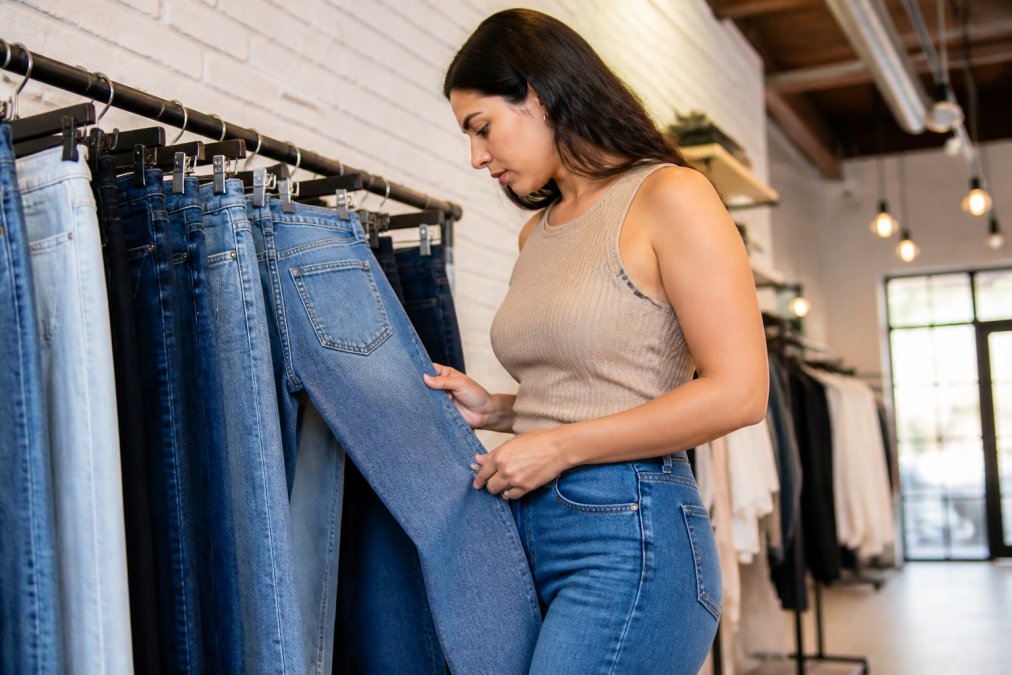
A common mistake is expecting sculpting jeans to function like shapewear. They're not designed to aggressively cinch or compress. Instead, they use subtle design tricks to enhance what you already have.
What most guides miss is that fit matters more than technology.
The Best Tummy Control Jeans for Office Wear
The best tummy control jeans for office wear balance compression with comfort. You need enough shaping to look polished but enough stretch to sit at a desk for eight hours without discomfort.
All-Day Comfort Without the Bunching
Bunching happens when compression fabric is too stiff or the fit is wrong. The fabric folds instead of smoothing, creating visible ridges under your shirt.
| Feature | What to Look For | Why It Matters |
|---|---|---|
| Waist height | High-rise, sits at natural waist | Smooths tummy without rolling down |
| Fabric stretch | 2-4% elastane | Allows movement, prevents bunching |
| Seam placement | Flat seams, no thick ridges | Invisible under fitted tops |
| Rise | 10-12 inches | Stays in place when sitting |
How to Style Wide-Leg Sculpting Jeans
Styling wide-leg sculpting jeans comes down to balance. The wide leg creates volume at the bottom, so you want to define the waist and keep the top relatively fitted.
Three approaches that work consistently:
- Tucked-in blouse or bodysuit that shows the high waist and creates a clean line
- Cropped jacket or blazer that hits at the waist and draws attention upward
- Fitted sweater or tee that contrasts with the wide leg
What Hip Lifting Jeans Cost and What You Get
Pricing for hip lifting jeans varies based on fabric quality, construction, and brand. Budget options often use lower-quality stretch that loses shape quickly. Premium options invest in better materials and construction that last longer.
Durability, Sizing, and the Trade-Offs Nobody Mentions
Durability is where most hip lifting jeans fail. Elastic fibers break down over time, especially with frequent washing and drying. The jeans that looked sculpting in month one may sag by month six.
To extend the life of your investment:
- Wash in cold water and air dry when possible
- Avoid fabric softener, which coats elastic fibers and reduces their ability to recover
- Turn jeans inside out before washing to reduce surface abrasion
- Rotate between multiple pairs to give elastic fibers time to relax between wears
- Check for fabric recovery by gently stretching a section of the thigh and releasing it, if it doesn't spring back within a second or two, the fiber is fatiguing
How to Measure for a Consistent Fit Across Brands
Sizing is the other trade-off, and it's the number one complaint in reviews of lifting denim. Hip lifting jeans often run differently than standard denim because the construction is cut to sit higher and hug differently. A common mistake is sizing down for more compression, which causes bunching, digging, and discomfort. Order your true size and let the construction do the work.
- Waist, measure across the top of the waistband, edge to edge, then double it.
- Hip, measure across the widest point of the seat, about 7 to 9 inches below the waistband, then double it.
- Rise, measure from the crotch seam straight up to the top of the waistband. Lifting cuts typically run 10 to 12 inches.
- Inseam, measure from the crotch seam down the inner leg to the hem.
The Comfort Trade-Off Nobody Advertises
High-compression denim can dig into the waist when you sit, restrict your stride, and create pressure points along the hip and thigh. This isn't a defect, it's the direct consequence of using tension to shape. If you have a long commute, sit for eight hours, or move frequently during the day, prioritize a cut with moderate compression and a higher rise, which distributes pressure over a larger area instead of concentrating it at the waistband.
Frequently Asked Questions
Do hip lifting jeans really work?
They work through construction rather than magic. Heart-shaped stitching, angled back pockets, and a fitted back yoke draw the eye upward and create the look of a rounder shape. Stretch denim with good recovery holds that shape while you move. The effect is visual and temporary, so results depend on how the jeans fit your specific body type. Trying a pair in your usual size is the only way to know how the lift reads on you.
How do you choose the right size for hip lifting jeans?
Start with your normal size and check the brand's fit guide, since compression denim often runs differently from standard jeans. Measure your waist and hip at home and compare against the chart rather than guessing. If you sit between sizes, size up: too-tight compression fabric restricts movement and creates the ridge under your shirt that people complain about. A 30-day return window makes it easier to test a size and exchange it.
Do hip lifting jeans lose their shape after washing?
Elastic fibers break down over time, and heat speeds that up. Wash in cold water, turn the jeans inside out, and skip the dryer. Air drying protects the stretch and helps the denim keep its recovery. Even with careful care, expect some softening after a year of regular wear. That lifespan is the main reason to weigh cost against how often you will actually wear the pair.
Are high-waisted sculpting jeans better for tummy control?
A higher rise covers more of the midsection, so it smooths a longer area than a mid-rise cut. Look for a wide, structured waistband that stays flat when you sit instead of rolling down. Pair that with stretch denim that has enough weight to hold its shape. The combination gives you control through the waist and hips without the stiff, restrictive feel of shapewear layered under regular jeans.