
Comfortable Jeans for All-Day Wear: 2026 Guide
Table of Contents
- What Actually Makes Jeans Comfortable All Day
- Best Jeans for Tummy Control That Actually Work
- Fits Built for Comfortable All-Day Wear
- How to Style Wide Leg Jeans for Any Occasion
- How to Choose the Right Size and Fit Online
- Sustainable Fabrics and Long-Term Comfort
- Conclusion
Last Updated: August 23, 2026
What Actually Makes Jeans Comfortable All Day
Comfortable jeans for all-day wear come down to three things: what the fabric does under pressure, how the waistband behaves when you sit for hours, and whether the seams stay out of the way. Most jeans fail on at least one of these counts. Here at AVERA7, we've spent time thinking through exactly what separates a pair you reach for every morning from one that ends up at the back of the closet after a single outing.
The real problem isn't that most denim is poorly made. It's that most denim is engineered for how jeans look in a dressing room, not how they feel six hours into a workday. A rigid waistband that photographs beautifully will dig in the moment you sit down for lunch. A stiff leg that looks clean and tailored will restrict your stride by midafternoon.
The good news: fabric science has advanced considerably, and the difference between a pair that works all day and one that doesn't is now measurable at the label.
Fabric Composition and Stretch Technology
Stretch denim is woven with elastane fiber, typically two to four percent spandex blended with cotton. That small percentage changes everything, offering meaningful ease of movement compared to rigid 100% cotton denim.
What matters beyond the elastane percentage is recovery: the fabric's ability to return to its original shape after stretching. Low-recovery stretch denim sags at the knees and seat within hours. High-recovery fabrics, often marketed as "shape retention" denim, hold their silhouette through a full day of movement.
Denim weight also affects comfort. Lighter-weight denim (measured in ounces per square yard) tends to feel softer and more breathable. For everyday style and long hours, a mid-weight fabric with an elastane blend is the most versatile choice.
According to Textile Exchange's fiber industry overview, blended fabrics that combine natural and synthetic fibers are among the most widely produced in the apparel industry, precisely because the combination delivers comfort properties that neither fiber achieves alone.
Rise Height, Waistband Design, and Seam Placement
High-rise jeans are more comfortable for all-day wear than low-rise or mid-rise options for most body types. A high rise sits at the natural waist, the narrowest point of the torso, so the waistband isn't fighting against your hip bones or lower abdomen when you sit, stand, or bend.
A mid rise sits across the widest part of the hip, creating pressure exactly where you don't want it during long sitting periods.
Waistband construction is equally important. A wide, flat waistband with internal smoothing technology distributes pressure evenly. Narrow waistbands concentrate pressure in a single line, causing the uncomfortable "roll" feeling after a few hours.
Seam placement is the detail most buyers overlook. Inner leg seams that run directly against the inner thigh create friction and irritation during walking. Better-constructed jeans position these seams slightly to the back or use flat-felled seams that lie flush against the fabric. Hardware and rivets should be recessed or positioned away from areas that press against furniture or skin.
Best Jeans for Tummy Control That Actually Work
The best jeans for tummy control work through structural support at the waistband, not through compression fabric alone. A high-waisted design that sits at the natural waist creates a smooth foundation across the lower abdomen without relying on tight elastic that digs in or rolls down.
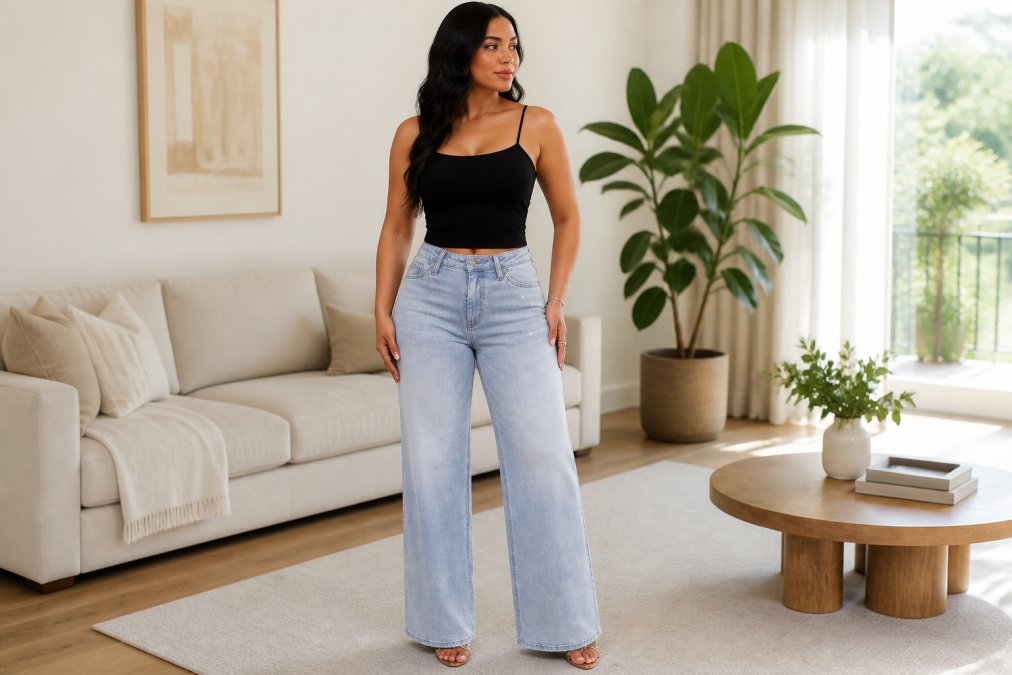
AVERA7's High-Waisted Wide Leg Jeans are designed specifically around this principle. The high-waisted design provides tummy control through fit architecture rather than compression alone, and the hip-lifting effect creates a sculpted silhouette that balances the relaxed wide leg cut. At $39.99, they're priced to make premium construction accessible. The brand holds a 4.8 out of 5 rating from customers, with a 30-day money-back guarantee if the fit doesn't work for you.

How to Avoid the Ridge-and-Bunch Problem
The ridge-and-bunch problem occurs when tummy-control fabric is too stiff to move with your body. The panel bunches under your shirt and creates a visible ridge at the top edge, exactly the opposite of what you wanted.
The fix comes down to two things: fabric flexibility and panel placement.
- Flexible fabric matters more than compression strength. A panel that stretches with you won't bunch. A rigid panel will.
- Panel height determines where the ridge appears. Look for panels that end at or just below the natural waist.
- Fit at the hip is the real test. If the jeans fit correctly at the hip, the waistband won't be fighting to stay up, which is the main cause of rolling and bunching.
When shopping online, check whether the waistband is described as "smoothing" versus "compressing." Smoothing technology works with your body's shape. Compression fights against it.
Fits Built for Comfortable All-Day Wear
The silhouette you choose affects how comfortable jeans feel across a full day more than most shoppers realize. Fit isn't just an aesthetic decision, it's a functional one.
Wide-Leg vs. Straight-Leg vs. Bootcut
| Fit | Best For | Ease of Movement | Silhouette Effect |
|---|---|---|---|
| Wide leg | All-day sitting, relaxed ease | Excellent | Elongates, balances hips |
| Straight leg | Versatile everyday wear | Good | Clean, classic proportion |
| Bootcut | Active days, varied movement | Good | Subtle flare, balanced |
| Relaxed fit | Casual, weekend wear | Excellent | Laid-back, casual |
A wide leg cut offers the most ease of movement because the fabric doesn't contact the leg through its full length. There's no friction against the thigh or calf, which makes a significant difference over a long day. A high-rise waist creates vertical proportion and lifts the visual center of the silhouette.
A straight leg is the most versatile option for women who move between settings throughout the day. It reads as polished enough for professional environments and relaxed enough for casual wear.
Bootcut jeans offer a slight flare below the knee that balances wider hips and works well with most shoe styles.
Sensory-Friendly and Postpartum Comfort
For women with sensory sensitivities, exposed rivets that press against the skin, scratchy interior seams, and stiff waistband linings are the most common issues. Sensory-friendly denim prioritizes soft interior finishing, minimal hardware at contact points, and a fabric texture that doesn't feel rough against skin. A high-quality cotton blend with elastane tends to feel softer than rigid denim.
Postpartum comfort is a specific and underserved need. The combination of a changed waist-to-hip ratio and a sensitive lower abdomen makes most standard jeans genuinely uncomfortable for months. High-waisted jeans with a flexible, non-compressive waistband are the most accommodating option because they provide gentle support without pressure on a healing abdomen.
According to American College of Obstetricians and Gynecologists postpartum care guidelines, the postpartum recovery period extends well beyond the first six weeks, and comfort in everyday clothing directly affects wellbeing during this time.
How to Style Wide Leg Jeans for Any Occasion
Wide-leg jeans are the most versatile silhouette in the current denim landscape. The key to making them work across occasions is proportion: the top you pair with them determines whether the look reads as polished, casual, or somewhere in between.

Workplace-Appropriate Looks
Workplace-appropriate styling with wide-leg jeans comes down to the top and the shoe. A tucked-in blouse or fitted knit top immediately elevates the silhouette from casual to business-casual. The tuck defines the waist, which keeps the wide leg from reading as shapeless.
Shoe choice matters more with wide-leg jeans than with any other cut. A pointed-toe flat or low heel extends the leg line through the hem. Avoid ankle boots that cut the leg line at mid-calf, the visual interruption shortens the silhouette.
For office settings, consider these combinations:
- Fitted turtleneck, tucked + wide-leg jeans + pointed-toe loafer
- Structured blazer over a simple cami, tucked + wide-leg jeans + kitten heel
- Fitted button-down, half-tucked + wide-leg jeans + clean white sneaker (creative offices)
The vintage-inspired cut of AVERA7's wide-leg jeans works particularly well with the tucked blouse approach because the relaxed leg cut contrasts with a defined waist in a way that reads as intentional and polished.
Casual and Weekend Outfits
The common mistake with casual wide-leg styling is going too relaxed everywhere at once. An oversized top with wide-leg jeans produces a shapeless result. The fix is contrast: if the bottom is relaxed, the top should be fitted or defined at the waist.
Weekend combinations that work consistently:
- Fitted crop top or baby tee + high-waisted wide-leg jeans + chunky sandals
- Fitted ribbed tank, tucked + wide-leg jeans + white sneakers
- Denim-on-denim: fitted denim jacket + wide-leg jeans in a contrasting shade
AVERA7's range of colors, including light blue, dark blue, black, gray, white, vintage light blue, medium blue, and washed blue, makes it straightforward to build both tonal and contrasting outfits without buying multiple pairs.
How to Choose the Right Size and Fit Online
Buying comfortable jeans online is harder than it should be because most brands use inconsistent sizing and generic fit descriptions. Here's a practical framework that reduces the risk of ordering the wrong size.
Step 1: Measure yourself, not your existing jeans. Take three measurements: natural waist (narrowest point above hip), hip (widest point), and inseam (crotch to ankle). Use these against the brand's specific size chart.
Step 2: Prioritize the hip measurement. For high-waisted wide-leg jeans, the hip is the most critical measurement. If you're between sizes, size up. A waistband that's slightly loose can be adjusted; a hip that's too tight will never be comfortable.
Step 3: Check the inseam length. Wide-leg jeans are designed to graze the floor or hit just above it. If the inseam is too short, the proportions collapse.
Step 4: Read the return policy before ordering. A brand that offers a clear return or exchange policy signals confidence in their sizing. AVERA7's 30-day money-back guarantee means you can test the fit in real conditions and return if it doesn't work.
Step 5: Check customer photos, not just product photos. Product photography is shot on a single body type under controlled conditions. Customer photos show how the jeans actually look across different sizes and proportions. A 4.8-star rating with real customer images is more useful than a polished editorial shoot.
As the Federal Trade Commission's guidelines on online shopping note, understanding a retailer's return and refund policy before purchasing is one of the most important steps in protecting yourself as an online shopper.
Sustainable Fabrics and Long-Term Comfort
Sustainable denim is increasingly relevant not just for environmental reasons but for comfort ones. The production processes used in more sustainably manufactured denim tend to result in softer, better-finished fabric.
Conventional denim finishing often involves harsh chemical washes that stiffen the fabric. More sustainable finishing methods, enzyme washes, ozone treatments, and reduced water processes, tend to preserve the fiber's natural softness. The result is denim that feels better from the first wear and maintains its texture longer.
Cotton quality is the other factor. Higher-grade cotton produces a finer yarn, which creates a smoother, softer fabric. A fabric with higher-quality cotton and a well-calibrated elastane percentage will hold its shape and softness through repeated washing in a way that cheaper blends won't.
According to Textile Exchange's 2025 Preferred Fiber and Materials Market Report, demand for more responsibly produced cotton has grown significantly as both brands and consumers recognize the connection between production methods and product quality.
Durability and sag resistance are the long-term comfort factors most buyers underestimate. A pair of comfortable jeans that sags at the knees after ten washes isn't actually comfortable. Shape retention, built through high-recovery elastane and quality finishing, is what separates a pair of jeans worth the price from one that disappoints.
Finding truly comfortable jeans for all-day wear means looking past the marketing language and evaluating fabric composition, waistband construction, and fit architecture together. AVERA7's High-Waisted Wide Leg Jeans address all three: the high-waisted design provides genuine tummy control through fit rather than compression, the hip-lifting effect creates a sculpted silhouette without sacrificing ease of movement, and the elastane blend delivers the flexibility and shape retention that all-day wear demands. At $39.99 with a 30-day money-back guarantee, they're worth trying on your own terms. Get started with AVERA7 and find out what all-day comfort in a flattering silhouette actually feels like.
Frequently Asked Questions
Are high-waisted jeans more comfortable for all-day wear?
High-waisted jeans distribute pressure more evenly across your midsection than low-rise styles, which often dig into your hip bones when you sit. A wide, structured waistband sits above the natural waist, reducing the risk of gapping at the back and providing light core support throughout the day. For women who want both comfort and tummy control, a high-rise cut in a soft elastane blend is generally the most practical choice for long hours of wear.
Do wide-leg jeans offer more comfort than skinny jeans?
Wide-leg jeans typically allow much more ease of movement than skinny styles because the fabric doesn't grip your thighs or calves. There's no compression along the leg, which means better breathability and less fatigue during long sitting or walking periods. The relaxed fit also accommodates different body shapes without pulling at the seams. A high-waisted wide-leg cut, like AVERA7's High-Waisted Wide Leg Jeans ($39.99), combines that freedom of movement with a structured waistband that keeps everything in place.
What features should I look for in comfortable jeans?
Focus on four things: fabric composition, rise height, waistband construction, and seam placement. A cotton-elastane blend with at least 2% elastane gives stretch and shape retention without sagging. A mid- or high-rise waistband prevents digging and gapping. Flat or minimal interior seams reduce friction against the skin, which matters most for all-day wear. Finally, check that the inseam and thigh seams are placed away from high-friction zones so the jeans stay comfortable whether you're sitting, walking, or standing for hours.
How can I tell if jeans will be comfortable before buying online?
Check the fabric breakdown first, a higher cotton percentage with a small elastane content usually signals softness and recovery. Read the size guide carefully and measure your natural waist and hips rather than guessing from your usual size. Look for a return or exchange policy (AVERA7 offers a 30-day money-back guarantee) so you're not stuck with a pair that doesn't fit. Customer reviews that mention body type and specific fit details are more useful than star ratings alone when you can't try jeans on in person.
This article was written using GrandRanker