
How to Measure Waist for Jeans: A 2026 Fit Guide
Table of Contents
- Why Your Jean Size Keeps Changing: Vanity Sizing Explained
- What You Need Before You Measure Waist for Jeans
- Step-by-Step: How to Measure Waist for Jeans at Home
- How to Measure Jeans Flat: The Flat Lay Method
- How to Measure Inseam for Jeans (and Why It Matters)
- Reading a Jeans Size Chart by Waist Measurement
- Fabric, Body Type, and Fit: What the Numbers Don't Tell You
- Common Mistakes When You Measure Waist for Jeans
- Frequently Asked Questions
Last Updated: September 17, 2026
Why Your Jean Size Keeps Changing: Vanity Sizing Explained
Vanity sizing means labeling garments with smaller numbers than their actual measurements, and it's why your jean size keeps shifting. A size 8 today can measure several inches larger than a size 8 from a decade ago. No federal standard ties a number to a measurement, so the tag tells you almost nothing, your real waist measurement does.
What You Need Before You Measure Waist for Jeans
You need three things: a flexible measuring tape, a mirror, and a fitted top.
Tools That Actually Give You an Accurate Reading
What works:
- Flexible measuring tape - accurate and easy to read
- String plus a ruler - a workable backup if you mark carefully
- A mirror - checks that the tape sits level
- Fitted top or bare midriff - bulky clothing adds inches you don't have
- A notebook or phone - write the number down immediately
Step-by-Step: How to Measure Waist for Jeans at Home
The direct answer: stand straight, find your natural waistline, wrap the tape snug but not tight, and read the number at eye level. It takes under two minutes.
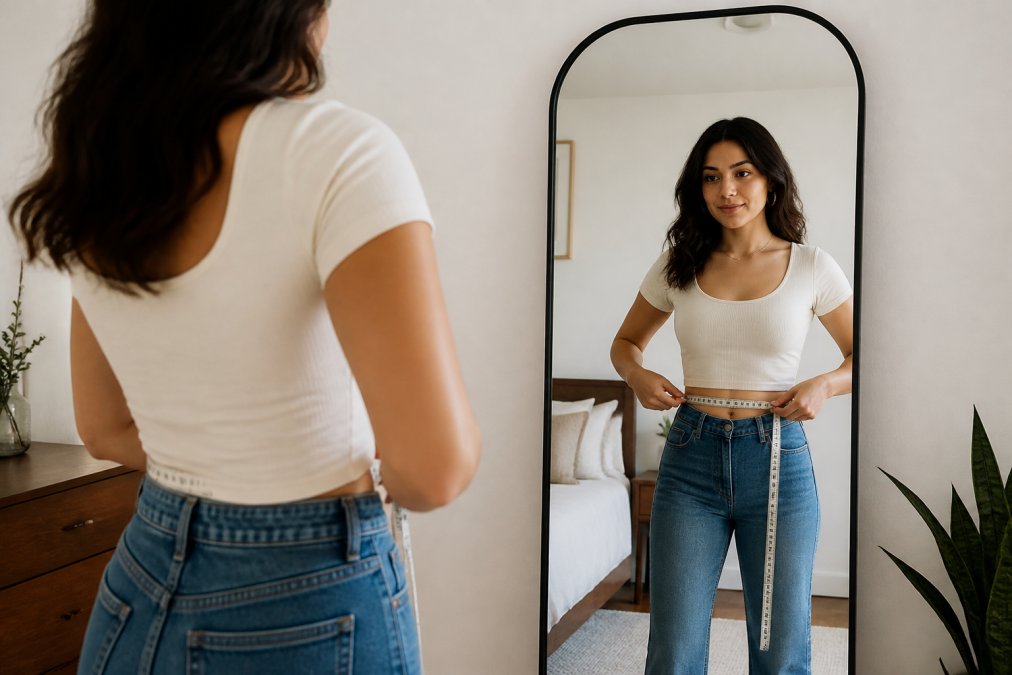
- Stand tall and relax. Breathe normally. Don't suck in.
- Find your natural waistline. It's the narrowest point of your torso, usually just above the navel and below the ribcage.
- Wrap the tape around. Keep it parallel to the floor all the way around.
- Check the mirror. The tape should sit level, not dipping at the back.
- Snug, not tight. The tape should touch your skin without pressing in.
- Exhale and read. Measure at the end of a normal breath, not a held one.
- Write it down. Note the number in inches.
Finding Your Natural Waistline vs. Your Jeans Waistband
Your natural waistline and your jeans waistband are not the same spot. Your natural waist is the narrowest part of your torso, above the navel; your jeans waistband sits wherever the rise puts it, at or above the navel for high-waisted styles, well below for low-rise.
Tape Tension, Level Tape, and Parallel Placement
Three things decide whether your number is right: tension, level, and parallel alignment.
How to Measure Jeans Flat: The Flat Lay Method
The flat lay method measures a pair of jeans you already own and love, the fastest way to find your true size in a new brand.
How to Measure Inseam for Jeans (and Why It Matters)
Inseam is the distance from the crotch seam to the hem. After your waist, it's the number that most often decides whether a pair looks intentional or accidental.
Why Your Body Inseam and Your Jean Inseam Differ
Your body inseam is a straight vertical line, but a jean's inseam runs along the inside of the leg, and the rise changes where that line starts. A high-rise pair has a longer rise, so the crotch seam sits higher and the inseam is shorter for the same finished length; a low-rise pair is the reverse.
Inseam by Height: A Starting Point, Not a Rule
Most brands publish inseam ranges by height as a rough guide:
- Under 5'4", petite or short inseams, often 27 to 29 inches
- 5'4" to 5'7", regular inseams, often 29 to 31 inches
- 5'8" and up, long or tall inseams, often 32 to 34 inches
How Fabric Changes the Inseam You Should Buy
Fabric affects inseam the same way it affects waist. Denim with a high stretch factor, usually a cotton and polyester blend with elastane, relaxes with wear and can stretch vertically as well as horizontally. Rigid 100% cotton holds its length and may shrink slightly after the first wash.
Hemming and Cuffing: When to Adjust Instead of Rebuy
If your inseam falls between two standard lengths, you have three options:
- Hem them. A tailor can shorten an inseam cleanly, and a raw or original hem can be preserved on most denim. The most reliable fix for a long inseam.
- Cuff them. A single or double cuff adds visual weight at the ankle and works with straight and wide legs. It does not fix a too-short inseam.
- Rebuy in a different length. If the inseam is too short and there is no fabric to let out, no adjustment will save it. Return and size up in length.
Inseam and Body Type: The Gap Most Guides Skip
Two people with the same waist and height can need different inseams because of leg-to-torso ratio. A long torso and shorter legs read shorter than your height suggests, so you may need a short or petite inseam even at average height; a short torso and long legs is the opposite.
Reading a Jeans Size Chart by Waist Measurement
A jeans size chart by waist measurement is the only reliable way to convert your number into a labeled size. Start with your natural waist in inches and find it in the brand's chart, but read the fine print, because some brands list body measurements and others list garment measurements.
| What You Have | What to Compare It To | What to Do |
|---|---|---|
| Natural waist measurement | Brand's body measurement chart | Match directly to the labeled size |
| Flat lay waistband (doubled) | Brand's garment measurement chart | Match to the garment number |
| Between two sizes | Fabric with high stretch | Size down for a snug fit |
| Between two sizes | Rigid, low-stretch denim | Size up for comfort |
Converting Your Waist Measurement to a Labeled Size
Use this quick process:
- Write down your natural waist in inches.
- Open the brand's sizing chart and find the body measurement column.
- Note the labeled size beside your number.
- Check the fit guide for notes on stretch and rise.
- If you're between sizes, decide based on fabric, not hope.
Fabric, Body Type, and Fit: What the Numbers Don't Tell You
Numbers get you close, but fabric and body type close the gap, and that's where the returns happen.
How Fabric Composition Changes the Size You Should Buy
Denim is not one material. The blend on the label tells you how the jean will behave after an hour of wear.
- 100% cotton (rigid denim). Holds its shape, does not stretch, may shrink slightly after the first wash. Buy your true measured size, or size up half an inch between sizes.
- Cotton with 1-2% elastane or spandex. Light stretch that gives at the waist and knee but recovers. Buy your true size.
- Cotton and polyester with 2% or more elastane. High stretch that relaxes noticeably at the waistband and seat. Between sizes, size down.
- Cotton, polyester, and rayon blends. Soft hand, high recovery, common in wide-leg and trouser-style jeans. Hold shape better than pure stretch denim but feel less rigid than 100% cotton.
Body Type Variations: Why the Same Waist Fits Differently
Two people with the same waist measurement can carry weight differently, which changes which cut works.
- Athletic or straight build. Waist and hips are close. Curvy cuts gap at the waist, look for straight, slim, or boyfriend cuts with a mid rise.
- Curvy build. Hips significantly wider than the waist. Straight cuts pull across the hip and thigh, look for curvy-specific cuts, high rises, or fabrics with at least 2% elastane.
- Apple or fuller-waist build. Waist fuller relative to the hips. Low rises dig in, look for high rises at the natural waist and stretch through the waistband.
- Tall build. Standard inseams run short and rises sit lower than intended, look for tall-specific lengths and check the rise measurement.
- Petite build. Standard rises sit too high and inseams too long, look for petite cuts or plan to hem.
Troubleshooting: What to Do When You Fall Between Sizes
The most common real-world problem, and most guides skip it.
- Check the fabric first. High stretch, size down. Rigid, size up.
- Check the rise. High rise sits at your narrowest point and is more forgiving; low rise sits where you are wider and is less forgiving.
- Check the cut. If the waist fits but the hips pull, the cut is wrong, not the size. Try a curvy or relaxed cut in the same size.
- Check the return policy. Truly between sizes with ambiguous fabric? Order both and return one, cheaper than a bad fit you keep.
- Do not size up to fix a gaping waist. A gaping waistband usually means the rise or cut is wrong, and sizing down will make the hips too tight.
Rise, Cut, and the Fit Problems They Solve
Rise is the distance from the crotch seam to the top of the waistband. It decides where the jean sits and is the single most under-used fit tool.
- High rise (10 inches or more). Sits at or above the natural waist. Best for fuller waists, curvy builds, and tummy control. Pairs well with wide-leg and straight cuts.
- Mid rise (8-10 inches). Sits just below the natural waist. The most versatile and safest bet if you are unsure.
- Low rise (under 8 inches). Sits on the hips. Best for straight or athletic builds, least forgiving for fuller waists.
Common Mistakes When You Measure Waist for Jeans
Most bad measurements come from five repeatable errors. Fix these and your number will hold up.
- Measuring over clothes. A thick sweater can add an inch or more. Measure against skin or a thin layer.
- Pulling the tape tight. Tension shrinks the reading. Snug, not tight.
- Letting the tape sag or ride up. A tape that isn't level is a tape that lies.
- Measuring the waistband instead of your body. These are different numbers. Know which one the chart wants.
- Trusting the label over the tape. Sizes vary by brand. Your measurement doesn't.
Frequently Asked Questions
Where exactly should you measure your waist for jeans?
Measure at your natural waistline, the narrowest point of your torso, usually just above your navel and below your ribcage. For low-rise or mid-rise jeans, measure where the waistband actually sits on your body instead. Use a flexible measuring tape, keep it level and parallel to the floor, and record the number in inches. This gives you the circumference you'll compare against a jeans size chart by waist measurement.
Should I measure my natural waist or where my jeans sit?
It depends on the rise you're buying. High-waisted styles sit at or above your natural waistline, so measure there. Mid-rise and low-rise jeans sit lower, closer to your hip bone, so measure at that point instead. If you're between sizes or unsure, measure both spots and use the larger number for comfort. A snug fit from the tape is fine, but it shouldn't dig into your skin.
How do I measure an existing pair of jeans to find my size?
Lay the jeans flat on a table, buttoned and zipped. Measure straight across the waistband from edge to edge, then double that number to get the full circumference. This is how to measure jeans flat, and it's the most reliable way to match a pair you already own. Compare that number to the brand's sizing chart, and check the fabric's stretch factor since high-elasticity denim can fit smaller than its flat measurement suggests.
Why do my jeans fit differently than my measurements suggest?
Vanity sizing is the main reason. Many brands label a 30-inch waistband as a size 8 or 10, even though the actual measurement is larger. Fabric composition also matters: a cotton and polyester blend with high elasticity stretches and molds to your body, while rigid 100% cotton denim holds its shape. Rise, inseam, and hip measurement all affect how a pair sits, so always check the brand's specific fit guide before ordering.
Getting the number right is only half the battle. The other half is finding jeans built to sit where that number actually is. AVERA7 designs high-waisted wide-leg jeans with a tummy-control waistband, a hip-lifting cut, and a soft cotton-polyester blend that moves with you all day. They come in eight colors and sizes XS to XL at $39.99, backed by a 30-day money-back guarantee and a 4.8 out of 5 rating. Get started with AVERA7 and stop guessing your size.