
Levi vs Premium Sculpting Denim Brands: 2026 Guide
Table of Contents
- Best Sculpting Jeans for Tummy Control: What Actually Works
- Levi vs Premium Sculpting Denim: Fabric Weight and Construction
- Premium Denim vs Mass Market Jeans: Price and Longevity
- High-Waisted Wide-Leg Jeans Benefits for Everyday Wear
- Levi vs Premium Sculpting Denim: Fit, Sizing, and Stretch
- Denim Care, Fade, and Environmental Impact
- Conclusion
- Frequently Asked Questions
Last Updated: September 10, 2026
Best Sculpting Jeans for Tummy Control: What Actually Works
Sculpting denim is a category of high-waisted jeans engineered with structured fabric, strategic paneling, and reinforced stitching to smooth the midsection and lift the hips without the bulk of shapewear. The best versions rely on fabric weight and construction rather than tight compression.
Most "tummy control" jeans compress everything, including the areas you don't want flattened, leaving a ridge under your shirt, a waistband that digs in by lunchtime, and a stiff rather than sculpted silhouette.
What separates the two approaches comes down to three things:
- Fabric weight: heavier denim holds its shape instead of collapsing into folds
- Panel construction: a wide, reinforced waistband distributes pressure evenly
- Rise and cut: a true high rise sits above the natural waist, so the smoothing effect starts higher
The denim market has split into two camps: mass-market jeans that use stretch percentage as a substitute for structure, and premium sculpting denim brands that invest in construction. Knowing which camp a pair falls into tells you more than any product description.
Levi vs Premium Sculpting Denim: Fabric Weight and Construction
Fabric weight, measured in ounces per square yard (oz/yd²), is the single most useful number when comparing denim. Mass-market jeans typically land in the 8-11 oz range, which keeps them soft and cheap to produce but limits structure (peer-reviewed research). Premium sculpting denim generally sits in the 11-14 oz range, enough body to smooth and lift without feeling like cardboard. Above 14 oz, denim can feel like raw workwear and may need a break-in period.
Levi's built its reputation on rigid and semi-rigid denim, and that heritage shows in the durability of its core styles. The 501 Original, for example, has historically been cut from around 12-13 oz rigid denim, genuinely heavy by modern standards. Where the brand's mass-market stretch lines differ from premium sculpting denim is in stretch content and paneling: a pair designed for comfort flexes with movement, while a pair designed to sculpt holds its shape and flexes less. That difference shows most clearly at the waistband, where a narrow, elastic-dependent band rolls and digs while a wide, structured panel distributes pressure across the midsection.
Stitching Density and Rivet Reinforcement
Stitching density, stitches per inch (SPI) along a seam, is one of the clearest signals of construction quality. Most mass-market denim runs 6-8 SPI on main seams, while premium construction typically runs 8-10 SPI at stress points, resisting seam failure at the crotch and back pockets. Flip jeans inside out and check the seam allowance: clean, tight, consistent stitching tends to hold up; loose, wavy stitching may fail first. Look specifically at the crotch seam and back yoke, these are common areas where denim can show wear first.
Rivets at pocket corners and stress points can help prevent tearing when you sit, squat, or carry a phone. On budget denim they're often decorative rather than functional, which can lead to pocket corners showing wear first: a functional rivet is set through the fabric and burred on the back side, while a decorative one is a flat stamp with no structural hold. Hardware durability extends to the zipper, a metal zipper with a sturdy pull tends to outlast the plastic alternatives common at lower price points. YKK zippers are an industry benchmark most premium brands specify: a metal-tooth zipper can hold alignment through hundreds of cycles, while a plastic coil zipper may skip teeth after a year of daily wear.
| Feature | Mass-Market Denim | Premium Sculpting Denim |
|---|---|---|
| Fabric weight | 8-11 oz | 11-14 oz |
| Stitching density | 6-8 SPI, single-stitch seams | 8-10 SPI, reinforced stress points |
| Rivets | Often decorative | Functional, burred reinforcement |
| Zipper | Plastic coil common | Metal-tooth (YKK-class) |
| Waistband | Narrow, elastic-dependent | Wide, structured panel |
| Back patch | Paper or printed | Leather or heavy bonded patch |
| Expected lifespan | 1-2 years of regular wear | Several years with proper care |
The back patch is a smaller tell: a paper or printed patch is cheap and degrades in the wash, while a leather or heavy bonded patch survives years of wear and signals the brand expects the garment to last. No single feature is decisive, but together they separate a pair built to hold a line from one built to hit a price point.
Premium Denim vs Mass Market Jeans: Price and Longevity
The price gap between premium denim and mass-market jeans comes down to fabric sourcing, construction time, and longevity. A pair that costs more upfront but holds its shape for years can often cost less per wear than a cheap pair replaced every season, and that matters most for sculpting denim, because a garment that loses its structure after ten washes may not sculpt effectively.
Mass-market jeans win on accessibility and low-risk color variety, you can try a trend without committing much money. They lose on consistency: sizing and fabric behavior vary between washes and even between colors of the same style.
Denim longevity depends on three factors: fabric weight, seam construction, and care. Heavier denim with reinforced stitching survives repeated washing far better than a lightweight stretch pair, though it feels stiff for the first few wears before molding to your body. Lightweight stretch denim feels comfortable immediately and stays that way until the elastane fatigues, at which point it sags.
High-Waisted Wide-Leg Jeans Benefits for Everyday Wear
High-waisted wide-leg jeans create a long, balanced line from the waist down while keeping the midsection smooth. The high rise sits above the natural waist, where the body is narrower, so the waistband anchors instead of sliding, and the wide leg falls straight from the hip to balance the silhouette rather than tapering toward the ankle.

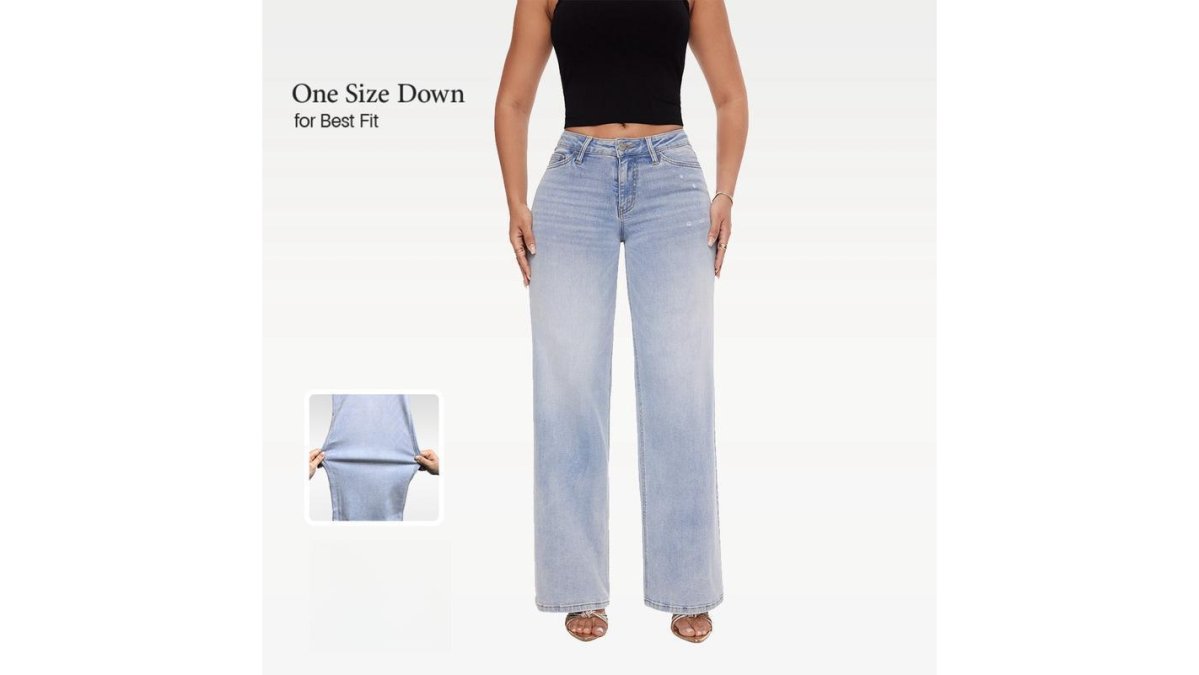
For all-day wear, the benefits stack up:
- Comfort across settings: a relaxed wide leg doesn't restrict movement the way skinny denim does, so the same pair works for a desk day and a weekend errand run
- Versatility: wide-leg jeans pair with sneakers, boots, and heels without needing a hem change
- Sculpted silhouette: the hip-lifting effect and the wide leg work together, so volume at the hem balances the waist rather than adding bulk at the hip
The vintage-inspired cut is where AVERA7's High-Waisted Wide Leg Jeans fit in: a structured high waist with a straight wide leg, available in shades from light blue to black, so the sculpting effect carries across a full wardrobe rather than one outfit.
Levi vs Premium Sculpting Denim: Fit, Sizing, and Stretch
Fit consistency is where mass-market denim and premium sculpting denim diverge most in daily use. Stretch percentage, usually a small number on the fabric tag, tells you how much a pair moves with you: more stretch means more give and comfort, but also more risk of sagging at the knee and waist over time.
Sizing consistency is a separate issue. Mass-market lines often cut the same nominal size differently across colors and fits, so two pairs of the same size can feel like two different garments. Premium brands hold their pattern blocks steadier, so a size 12 in one color fits like a size 12 in another.
Shrink-to-fit denim is the exception worth knowing: unwashed, rigid denim can shrink after the first wash, which is why some raw denim is sold with the expectation that it will tighten. Most sculpting denim is pre-washed and pre-shrunk, so what you try on is close to what you keep. Sizing advice that ignores this distinction leads people to buy the wrong size and blame their body instead of the garment.
Denim Care, Fade, and Environmental Impact
Denim care directly affects how long a sculpting pair keeps its shape, and it shapes the fade pattern that gives denim its character. Washing jeans inside out in cold water on a gentle cycle and air-drying preserves both structure and color. Hot water and high-heat drying can break down elastane faster than anything else, a main reason stretch denim may lose its fit. A pair with 2% elastane that is tumble-dried weekly may lose meaningful recovery within a season; the same pair air-dried can help hold its shape for years.
How Fades Actually Develop
Denim fade is a feature, not a defect, when it develops gradually. Indigo dye sits on the surface of the cotton fiber rather than penetrating to the core, so abrasion wears the dye away and reveals white yarn underneath. Fades appear first at the highest-friction points: whiskers across the front hip creases, honeycombs behind the knees, and a phone outline on the front pocket. Rigid and raw denim develop these patterns over months of wear, and collectors pay a premium for a personal fade map.
Pre-distressed and washed finishes skip that process by fading the denim before it reaches you, but the fade is uniform and generic, you get the look immediately and never develop your own. For a fade that is uniquely yours, wash less often, spot-clean between washes, and accept that the first six months set the pattern. Many denim enthusiasts go 30-60 wears between washes during the initial fade period, then wash more normally once the pattern is set.
Sculpting denim sits in a middle category: because it usually contains stretch and is pre-washed, it won't develop dramatic high-contrast fades the way raw denim does. What it can do is hold its color longer with a cold-wash, air-dry routine, which matters more for a garment you wear to work than for a pair you wear to break in.
Water Use and the Environmental Angle
Environmental impact is the angle most denim comparisons skip entirely. Denim production is water-intensive, and conventional finishing methods use significant amounts of water and chemicals. According to the EPA's guidance on textile manufacturing and water use, reducing water and chemical use in textile finishing is a growing priority for the industry. The practical takeaway for shoppers is that denim maintenance extends a garment's life, and a longer life means fewer replacements and less waste. One of the highest-impact choices a denim buyer makes is not which brand to buy but how long they keep the pair they already own.
Washing less frequently is the simplest lever. Every wash cycle uses water, exposes the fabric to agitation, and shortens the garment's life. Spot-cleaning between washes, airing jeans overnight, and freezing them to manage odor (a debated but low-cost practice) all extend the interval between full washes. When you do wash, cold water and air-drying cut both energy use and fabric wear.
The FTC's guidance on textile labeling and care claims is worth checking if a brand makes specific sustainability claims, since those claims have to be substantiated. Terms like "sustainable denim" and "eco-wash" are not regulated on their own, so the burden is on the shopper to look for specifics, a named water-reduction process, a published water-use figure, or a third-party certification.
Caring for denim well is the simplest environmental choice available: wash less, wash cold, air-dry, and repair before replacing. A pair that lasts five years instead of one can do more for the environment than many single purchase decisions.
Conclusion
Choosing between heritage denim and premium sculpting denim comes down to what you need the garment to do. If you want a pair that holds its shape, smooths the midsection, and keeps its structure through years of wear, construction quality matters more than brand recognition.
AVERA7 offers high-waisted wide-leg jeans with a high-waisted design for tummy control, a hip-lifting effect for a sculpted look, and a relaxed vintage-inspired cut in multiple versatile colors. With an excellent 4.8 out of 5 rating and a 30-day money-back guarantee, trying a pair carries little risk. Get started with AVERA7 and find a pair that sculpts without squeezing.
Frequently Asked Questions
Is there a difference between Levi's and Levi's Premium?
Levi's Premium uses heavier denim and upgraded hardware compared to standard Levi's lines. If sculpting is your priority, look for denim above 10 oz with at least 2% elastane and reinforced rivets at stress points.
Do sculpting jeans actually provide a flattering silhouette?
Yes, when the construction supports it. A high-waisted design with a hip-lifting effect and dense stitching holds shape without bunching. Fit and sizing consistency matter more than the label. Consider brands with an excellent 4.8 out of 5 rating and a 30-day return policy so you can test the silhouette on your body before committing.
How do high-waisted wide-leg jeans compare to traditional fits?
High-waisted wide-leg jeans elongate the leg line and balance the hip-lifting effect, while traditional mid-rise skinny fits compress rather than sculpt. The relaxed vintage cut also allows all-day soft comfort without the restrictive feel common in sculpting denim. For postpartum mothers or anyone wanting tummy control, the high rise plus wide leg combination is usually more forgiving.
Are premium denim brands worth the higher price point?
It depends on what you're paying for. Premium denim above $100 often delivers heavier fabric, denser stitching, and better hardware durability. Check fabric composition, stretch percentage, and return policy before deciding.