
Where to Buy Flattering Wide Jeans: 2026 Fit Guide
Table of Contents
- Why Wide-Leg Jeans Flatter More Body Types Than You Think
- Best Wide Leg Jeans for Tummy Control: What to Look For
- Where to Buy Flattering Wide Jeans: Retailers That Get Fit Right
- How to Style Wide Leg Jeans for Work, Weekends, and Evenings
- Inseam, Tailoring, and the Petite vs. Tall Fit Guide
- Building a Capsule Wardrobe Around One Pair of Wide-Leg Jeans
- Common Mistakes When Shopping for Flattering Wide Jeans
- Frequently Asked Questions
Last Updated: September 14, 2026
Why Wide-Leg Jeans Flatter More Body Types Than You Think
Wide-leg jeans have a reputation problem: shoppers assume a wider leg means added bulk, so they stick to skinny cuts. That assumption is backwards. A well-cut wide-leg pair creates a vertical line from hip to hem that elongates the body instead of chopping it into sections.

The trick is proportion, not width. When the waistband sits high and the fabric falls cleanly, the eye reads length rather than volume. This guide from AVERA7 breaks down where to buy flattering wide jeans, what to check before you order, and how to style them.
The Silhouette Myth: Wide Legs and Visual Weight
The idea that wide legs add pounds only holds when the fabric is stiff and the rise is low. A high-rise waistband anchors the eye at your natural waist, then releases into a straight or gently flared leg (Exhibit tags: Garments - Go Figure: The Fashion Silhouette and the Female Form). That contrast is what makes the cut flattering.
Fit guides from fashion and textile researchers at Cornell University note that garment silhouette and vertical line strongly influence how viewers perceive body proportion. In practice, this means the leg opening matters less than where the denim breaks and how it drapes.
Best Wide Leg Jeans for Tummy Control: What to Look For
The best wide leg jeans for tummy control combine a high rise, a firm but stretchy waistband, and fabric that holds its shape without bunching. Look for a contoured waistband above the navel and a front panel that lies flat under a tucked-in shirt. But "flattering" depends on where you carry weight, so here's how to read a wide-leg cut against your own shape.
Find Your Fit: A Shape-by-Shape Guide
Apple (weight through the midsection, slimmer legs). Prioritize a high rise that reaches your natural waist and a structured, contoured waistband that dips in front and rises in back. Avoid pleats, gaping front pockets, and fabric thin enough to show the waistband edge. A wide leg balances a fuller midsection by adding visual width below, which is why this shape often looks best in wide-leg denim.
Pear (weight through hips and thighs, narrower shoulders). Keep the hip line clean and let the leg fall straight from the widest point. Look for a rise at or just below the natural waist, a flat front with no whiskering, and a leg that opens gradually rather than flaring at the knee. A uniform dark wash does the job with less fuss than a two-tone trick.
Hourglass (defined waist, balanced hips and bust). The risk is a waistband that gaps because the hip is wider than the waist. Look for a higher waist-to-hip ratio, or budget a $15-$25 back-waistband alteration. A high rise at the narrowest point of your waist preserves proportion; a mid-rise across the widest part of the hip flattens the silhouette.
Rectangle (straight through waist and hip). A wide leg can create the illusion of curve if the waistband is defined. Tuck your top, add a belt, and choose a cut with a slightly higher rise to break the vertical line at the waist rather than the hip.
High-Rise vs. Mid-Rise: Which Waistband Actually Smooths
High-rise wins for smoothing, and it isn't close. A waistband at the natural waist compresses the midsection evenly and prevents the "muffin ridge" mid-rise cuts create when you sit. Mid-rise is fine for casual weekends, but for tummy control, high-rise is the better investment.
Fabric Weight and Stretch: The Hidden Fit Factor
Fabric composition decides whether jeans skim or cling. Heavier denim with a small percentage of stretch holds a clean line; thin, over-stretchy fabric bags at the knee by midday (Low-bagging (growth) stretch denim yarn production by spinning optimization of...). Look for a mid-weight cotton blend with enough give to sit comfortably but enough body to keep its shape, the more stretch a fabric has, the faster it loses shape, so trade some comfort for a firmer hand.
| Fabric Type | Hold | Comfort | Best For |
|---|---|---|---|
| Rigid denim | Strong | Firm | Structured, dressy looks |
| Mid-weight stretch | Balanced | High | All-day wear |
| Lightweight stretch | Low | Highest | Warm weather, casual |
AVERA7's High-Waisted Wide Leg Jeans are built around this brief: high-waisted tummy control, a hip-lifting effect, and a relaxed, vintage-feel wide-leg cut. At $39.99, they offer premium quality.
The Fit Check Before You Commit
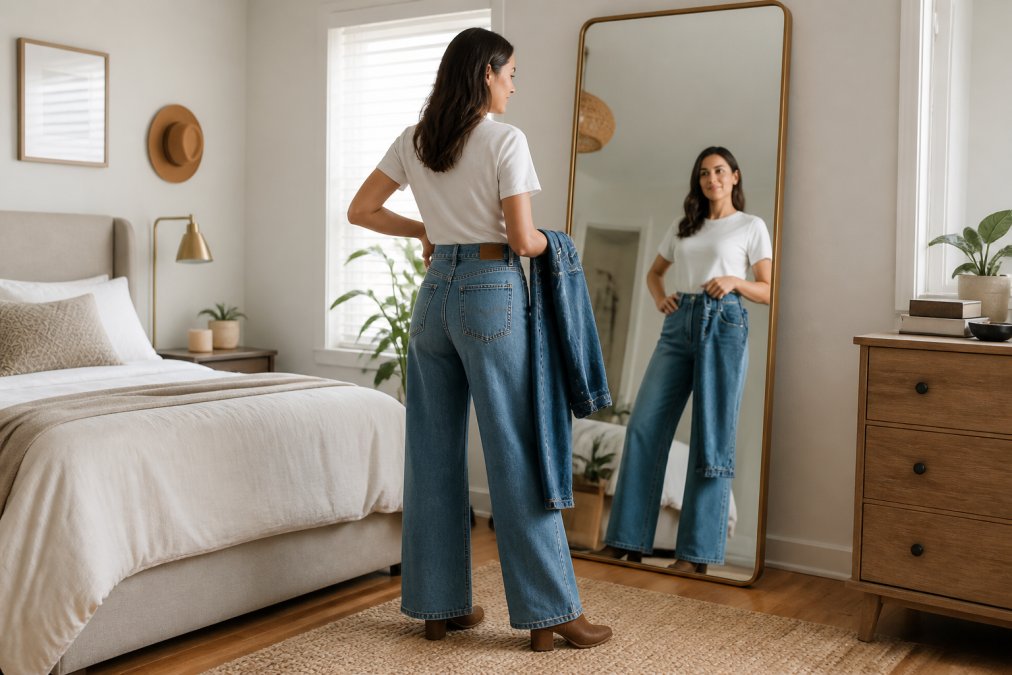
Before you cut the tags, run through this in front of a mirror:
- Sit down. Does the waistband dig or gap? If it gaps at the back, size down or budget for a waistband alteration.
- Tuck a shirt. Does the front panel lie flat, or does it bunch under the button?
- Check the break. Does the hem graze the top of your foot, or pool on the floor?
- Walk ten steps. Does the fabric bag at the knee or hold its line?
If a pair passes all four, it's the right cut for your shape, regardless of what the size tag says.
Where to Buy Flattering Wide Jeans: Retailers That Get Fit Right
The best place to buy flattering wide jeans is a retailer that publishes real fit details: rise measurement, inseam options, fabric weight, and customer photos on different body types. Online-only brands often win here with more model diversity than a single store rack.
Online-Only Brands vs. In-Store Try-Ons
In-store try-ons let you test the rise and leg opening immediately, but store lighting and limited sizing often push shoppers toward the wrong fit. Online shopping offers more washes and inseam lengths, provided the brand has a clear return window.
How to Style Wide Leg Jeans for Work, Weekends, and Evenings
Styling wide-leg denim comes down to balancing volume with a defined waist. Tuck your top, add a belt, and let the leg do the rest. These 5 pairings move the same jeans from desk to dinner.
- Work: Tucked-in blouse, structured blazer, pointed flats or low heels
- Weekends: Cropped tee, sneakers, crossbody bag
- Evenings: Fitted bodysuit, heeled ankle boots, statement earrings
- Cold weather: Fine-knit sweater tucked in, long coat, leather ankle boots
- Summer: Linen shirt knotted at the waist, sandals, straw tote
Footwear Pairing: Ankle Boots, Sneakers, and Heels
Ankle boots with a slight heel lengthen the leg line and keep a wide hem from swallowing your feet. Sneakers work when the hem breaks just above the shoe. Heels add height, but a chunky platform can shorten the line, a slim heel or pointed toe is safer for evening.
Inseam, Tailoring, and the Petite vs. Tall Fit Guide
Inseam is the most overlooked number in denim shopping, and it decides whether a wide leg looks intentional or sloppy. Unlike a skinny jean, a wide-leg hem can't just be chopped and forgotten, the leg opening is wide enough that any change to its angle shows up in the drape. That's why most wide-leg denim disappoints at the hem, not the waist.
Start With Your Real Inseam, Not Your Height
Measure a pair of pants you already like: lay them flat, run a tape from the crotch seam down the inner leg to the hem. That number, not your height, is what you shop against. As a rough guide:
- Petite frames (under 5'4"): 27-29 inch inseam usually grazes the top of the foot without pooling
- Average frames (5'4"-5'7"): 30-32 inch inseam breaks once at the ankle
- Tall frames (5'8" and up): 33 inches or more, or a cut explicitly designed for a longer leg
A wide leg that pools on the floor reads as borrowed; a wide leg that breaks once reads as tailored. The difference is usually two inches.
Why Wide-Leg Hems Are Harder to Alter
A standard straight or skinny hem is a simple horizontal cut. A wide-leg hem often has a slight flare or curved sweep, and shortening it straight across narrows the leg opening and flattens the silhouette into a bootcut. The flare lives in the hem width, so the hem must be preserved, not just raised.
Three approaches work, in order of how invisible they are:
- Original-hem reattachment. The tailor removes the existing hem, shortens the leg from above, then sews the original hem back on. The factory finish and the leg opening stay intact. This is the cleanest result and the one to ask for by name.
- Tapered re-hem. The tailor shortens and re-angles the hem to keep the opening width proportional to the new length. Works well on gently flared cuts, less well on dramatic ones.
- Raw or cut hem. Trim with sharp fabric shears and leave it unfinished, or fray it slightly with a nail file. Casual, forgiving of a slightly uneven line, and reversible, but it will continue to fray with each wash, so trim again as needed.
Petite Frames: Stop the Pool
For petite shoppers, the goal is a hem that grazes the top of the foot with no fabric touching the ground. If the shortest inseam is still too long, original-hem reattachment is worth the cost, a straight chop turns a flattering cut shapeless. A cropped wide leg ending just above the ankle bone is also a legitimate petite strategy; it shows the shoe and keeps the vertical line unbroken.
Tall Frames: Find the Break
Tall frames usually need a longer inseam than most brands stock, so look for brands that publish inseam length per wash and treat 33 inches as a floor, not a target. A wide leg that breaks once at the ankle and falls straight is the goal. If you can't find the length, buy the longest option and hem it to your exact break point rather than settling for a mid-calf cut.
What Tailoring Costs and When It's Worth It
A basic hem typically runs $15-$30, with original-hem reattachment at the higher end because it's more labor. On a $39.99 pair that's a meaningful percentage, but a $20 hem on jeans you'll wear twice a week for two years beats a $120 pair that never quite fits. If the jeans are under $50 with a simple straight cut, a raw hem at home is a reasonable DIY; if the cut has a pronounced flare, pay the tailor.
Building a Capsule Wardrobe Around One Pair of Wide-Leg Jeans
One well-chosen pair of wide-leg jeans can anchor a capsule wardrobe. Start with a versatile wash like medium blue or black, then build around pieces that tuck cleanly and pair with the same shoes.
- One tucked-in white tee
- One structured blazer
- One fine-knit sweater
- One fitted bodysuit
- Ankle boots and clean sneakers
Common Mistakes When Shopping for Flattering Wide Jeans
Most disappointing wide-leg purchases trace back to three fixable errors: ignoring the rise, guessing the inseam, and buying fabric that's too thin.
- Skipping the rise measurement: A low rise flattens the tummy-control effect entirely
- Guessing your inseam: Order your real length or plan for tailoring
- Chasing maximum stretch: Over-stretchy denim loses shape by afternoon
- Avoiding the tuck: An untucked top hides the waist and adds bulk
Sustainable denim shoppers can also check how a brand handles washes and materials before buying, since lower-impact production is increasingly part of the purchase decision.
Frequently Asked Questions
What are the most flattering wide leg jeans for petite frames?
Petite frames benefit from a high-rise wide-leg cut with a shorter inseam, ideally 27 to 29 inches, so the hem breaks just above the shoe without pooling. Look for a leg opening between 18 and 22 inches; anything wider can swallow your frame. A dark or medium indigo wash also creates an unbroken vertical line. If the inseam runs long, a tailor can hem it, which is worth the cost for a pair you'll wear weekly.
How should wide leg jeans fit at the waist and hips?
The waistband should sit snug against your lower back with no gap when you bend or sit, and the hips should skim your body without pulling across the front pockets. A common mistake is sizing up for comfort in the legs, which leaves the waist loose. If the waist gapes but the hips fit, that's a sign you need a cut with a higher rise or more stretch. Rigid denim relaxes about half an inch after wear; stretch denim holds its shape.
Do wide leg jeans make you look shorter?
Only when the proportions are off. A high-rise waist elongates the leg line, and a hem that grazes the top of your shoe creates one continuous vertical line from waist to floor. Avoid cropped wide-leg styles that cut at the widest part of your calf, and pair with a tucked-in top or a belt to define the waist. Ankle boots with a pointed toe or a slight heel add height without looking like you're trying too hard.
What features should I look for in flattering wide leg denim?
Prioritize a high-rise or mid-rise waistband that hits at or above your belly button, a fabric blend with 1 to 3 percent elastane for all-day comfort, and a leg opening that balances your frame rather than overwhelming it. Dark washes with minimal distressing read more polished, while vintage washes work for casual outfits. Check the return policy before buying online; a 30-day money-back guarantee lets you test the fit at home without risk.
Finding wide-leg jeans that actually flatter comes down to rise, inseam, and fabric, not luck. AVERA7 builds its High-Waisted Wide Leg Jeans around a high-waisted design, a hip-lifting effect, and all-day soft comfort in multiple versatile colors, backed by a 4.8 out of 5 rating and a 30-day money-back guarantee. Get started with AVERA7 and find the pair that earns a permanent spot in your rotation.