
Best Yoga Pants for a Flattering Silhouette in 2026
Table of Contents
- What Makes Yoga Pants Flattering: A Repeatable Silhouette Test
- Why High-Waisted Yoga Pants Do the Heavy Lifting
- Yoga Pants with Tummy Control: What Actually Works
- Yoga Pants for Curvy Figures: Fit Guidance by Proportion
- Wide-Leg Yoga Pants: Balance, Length, and Movement
- Squat-Proof, Opaque, and Built to Last: The Durability Check
- How to Choose: Price, Size Range, and Use-Case Trade-Offs
- Conclusion
- Frequently Asked Questions
Last Updated: October 18, 2026
What Makes Yoga Pants Flattering: A Repeatable Silhouette Test
Finding the best yoga pants for a flattering silhouette comes down to four checkpoints you can test in a fitting room in under five minutes. At AVERA7, we judge every pair against waistband behavior, rise, seam placement, and opacity, because those four details decide whether fabric sculpts your shape or fights it. Get them right and almost any body type looks balanced.

A flattering silhouette is the visual effect created when a garment's waistband, rise, seams, and fabric work together to smooth the midsection, lift the seat, and elongate the leg line without pinching or pulling.
Most guides tell you to "look for support" and leave it there. That advice is useless in a store. Here is the test we actually run:
- Waistband: Bend, twist, and sit. The band should stay flat against your back with no roll-down and no gap.
- Rise: The top edge should land at or just above your natural waist, not across your hip bones.
- Seam placement: A contoured back seam that curves upward lifts the seat. A straight horizontal seam flattens it.
- Opacity: Squat in front of a mirror under bright light. If you can see a hand through the fabric, it fails.
Run those four checks in that order. Whichever pair passes all four is the pair worth your money.
Why High-Waisted Yoga Pants Do the Heavy Lifting
High-waisted yoga pants work because a wide band above the natural waist distributes pressure across a larger area, which smooths the midsection instead of squeezing it into a bulge. The rise does the structural work; everything else is refinement.
The difference between a good high rise and a bad one is measured in centimeters of band width. A narrow band digs in and rolls. A wide, flat band sits still through forward folds and deep squats.
How to check a waistband for roll-down before you buy
Do this before you take the tags off:
- Sit down and lean forward for ten seconds
- Check whether the back of the band has folded over
- Stand and twist your torso left and right
- Run a finger under the front edge: it should lie flat, not curl
- Confirm the band covers your navel without riding up
If the band rolls during any of those movements, it will roll during a vinyasa flow. Return it.
Yoga Pants with Tummy Control: What Actually Works
Yoga pants with tummy control work when the compression comes from fabric engineering and panel construction, not from a tight elastic band. Look for four-way stretch and a wide, no-roll waistband; skip anything that feels restrictive around the ribs.
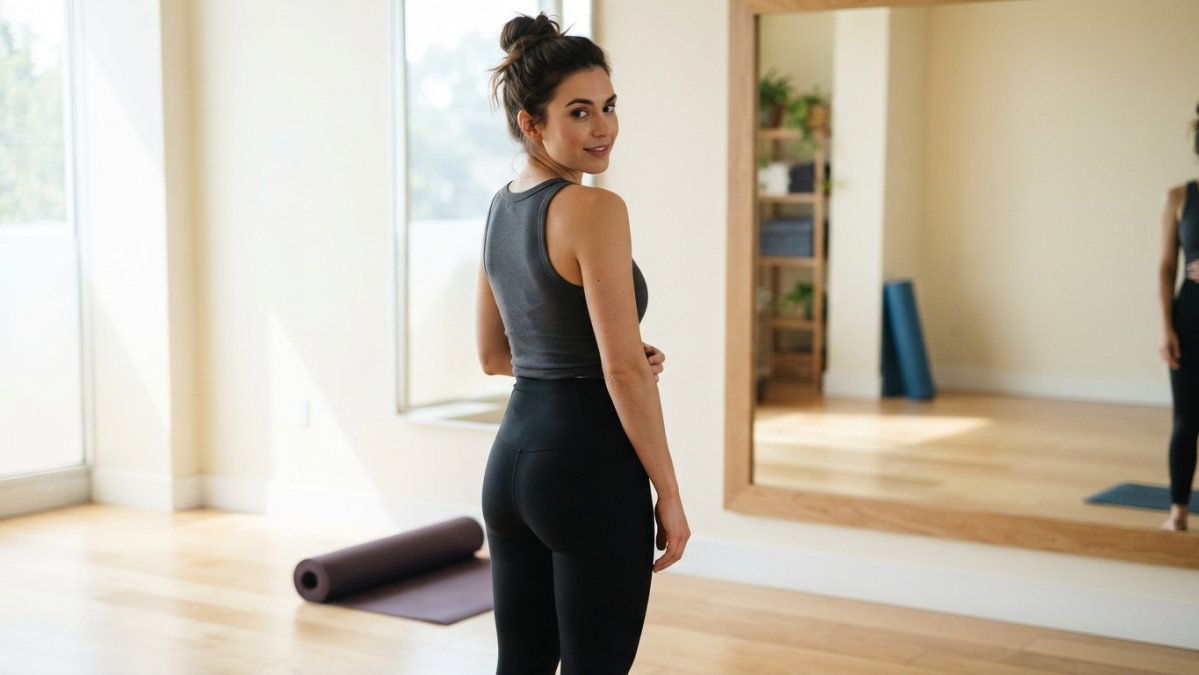
The tell is in how the pants feel after two hours, not two minutes. Real tummy control should feel supportive and forgettable.
A common mistake is sizing down to get more compression. That backfires: the fabric stretches thinner, opacity drops, and the band rolls. Buy your true size and let the construction do the work.
Yoga Pants for Curvy Figures: Fit Guidance by Proportion
Yoga pants for curvy figures should follow proportion, not a single "curvy" label. The goal is balance: a supportive waistband that does not cut in, a rise that clears the hip curve, and seam placement that follows your shape rather than flattening it.
Start with three measurements taken over light clothing: natural waist (the narrowest point above the navel), high hip (about three inches below the waist), and full hip (the widest point). Write them down.
How to interpret the size chart
- If your hip measurement falls in a larger size than your waist, buy for the hip and plan to use the drawcord or a tailor to take in the waist. Sizing down to match the waist is what creates the roll-down and the see-through stretch at the seat.
- If your waist and hip land in different sizes and the chart offers a "curvy" or "curvy fit" option, that cut usually adds room through the hip and thigh without widening the waistband. It is worth trying before you resort to tailoring.
- If you are between sizes, size up for compression fabrics and stay true to size for soft, four-way stretch fabrics. Compression fabric has less give; soft fabric recovers.
Inseam and rise guidance by proportion
| Your Proportion | What to Prioritize | What to Avoid |
|---|---|---|
| Fuller hips and thighs | Contoured back seam, four-way stretch, curvy fit if offered | Straight horizontal back seams, single-layer fabric at the seat |
| Shorter torso | Mid-to-high rise, narrower band (about 3 inches) | Very tall rises that bunch at the ribs |
| Longer torso | Full high rise, wide flat band (4 inches or more) | Low-rise cuts that slide down |
| Softer midsection | Wide no-roll band, firm compression, gusseted crotch | Thin elastic waistbands, single-layer front panels |
| Athletic build | Seam detail for shape, medium compression | Over-compression that flattens curves |
Treat the table as a starting point, not a rulebook. Bodies do not sort neatly into rows, and the four-checkpoint test still decides. A pair that passes the waistband, rise, seam, and opacity checks in your true size will outperform a pair that matches a label but fails the movement test.
Wide-Leg Yoga Pants: Balance, Length, and Movement
Wide-leg yoga pants balance a fitted high waist with volume through the leg, which creates an elongating effect and keeps the silhouette from looking top-heavy.
Rise and waistband matter more in a wide leg
A wide-leg pair with a low or mid rise will slide during forward folds because the leg volume pulls downward with nothing to counter it.
Length and inseam by use case
Length is where most people get it wrong, and the right answer depends on what you are doing in them.
- Studio practice: A full-length wide leg should skim the floor in bare feet so it breaks cleanly over a sneaker without dragging. If you practice barefoot, hem to within half an inch of the floor; if you wear shoes, add that half inch back.
- Everyday wear: A 7/8 or cropped length that hits just above the ankle bone keeps the leg line unbroken and avoids the hem catching on stairs or escalators. This is the safer choice for commuting and all-day wear.
- Restorative and lounging: A full-length, heavier fabric drapes better and does not cling, but it is the least practical for walking or running errands.
Measure your inseam from crotch to ankle bone and match it to the chart.
Fabric weight and movement trade-offs
Wide legs in a light, four-way stretch fabric flow well but can cling to the leg in humid conditions and show the outline of underwear.
Check range of motion before you commit. Wide legs can catch on the heel in a flow class, and a longer inseam can drag during walks.
Squat-Proof, Opaque, and Built to Last: The Durability Check
Squat-proof means the fabric stays fully opaque through a deep bend under bright light. Durability means it still does that after a season of washing. Both are testable, and both are where cheap pants fail first.
Our Butt-Lifting Yoga Pants are built around this exact problem: a 90% nylon, 10% spandex blend with a honeycomb-textured compression fabric, contoured seaming, a scrunch-back detail, and a wide no-roll waistband. The listing describes the fabric as squat-proof and non-see-through, with moisture-wicking and quick-dry performance.
For care, machine wash cold with like colors, then tumble dry low or hang to dry. Skip bleach and skip the iron. Heat is what breaks down spandex, and once elasticity goes, the lift goes with it.
How to Choose: Price, Size Range, and Use-Case Trade-Offs
Choosing comes down to three trade-offs: how much compression you want, how long the inseam needs to be for your height, and whether the pair has to work for studio practice or all-day wear. Price matters, but it ranks below fit.
On sizing, our Butt-Lifting Yoga Pants run true to size with a snug, compressive fit. If you are between sizes or prefer a looser feel, the listing recommends sizing up. The range runs S through XXL.
On price and value, a lower-priced pair can be the smarter buy if it passes all four checkpoints. The Federal Trade Commission's guidance on clothing care labels is worth a read if you want to understand what those care tags actually require manufacturers to disclose.
For use cases, fitted cuts suit flow and strength work; wide legs suit restorative practice and everyday wear. Buy for the majority of your week, not the one class you take on Saturdays.
Conclusion
The hard part is not finding yoga pants. It is finding a pair that still passes the four checkpoints after a month of wear, when the band has been through twenty washes and the seams have been tested in every fold. Most pairs do not make it that far.
AVERA7 builds for that longer test. Our high-waisted designs pair a wide, no-roll waistband with contoured seam placement and a hip-lifting effect, in a four-way stretch fabric that is squat-proof and moisture-wicking, backed by a 4.8 out of 5 rating and a 30-day money-back guarantee. Start with our Butt-Lifting Yoga Pants at $19.99 and run the test yourself.
Frequently Asked Questions
What are the most flattering yoga pants for a big tummy?
Look for a wide, no-roll waistband that sits at or just above the navel, a high rise, and a fabric with enough compression to smooth without pinching. Yoga pants with tummy control work best when the waistband is tall and flat rather than elastic and gathered. Check the seam placement too: a contoured back seam lifts the glutes and draws the eye upward, which balances the midsection. Opaque, four-way stretch fabric keeps everything in place through movement.
Are high-waisted yoga pants more flattering than low-rise?
For most body types, yes. High-waisted yoga pants create a longer leg line and hold the midsection without cutting across it. A high rise also keeps the waistband from rolling down during forward folds or squats. The key is the band itself: a wide, flat band that stays put beats a thin elastic one. If the waistband digs or gaps at the back, size up or try a different cut.
Which yoga pants are best for curvy figures?
Yoga pants for curvy figures should have a rise that clears the widest part of the hip, a waistband that does not gap at the back, and enough four-way stretch to move without sheerness. Contoured seaming and a scrunch-back detail can enhance curves rather than flatten them. Check the size range before ordering and read fit notes for hip-to-waist ratios. A snug, compressive fit that stays opaque in a squat test is the goal.
Are wide-leg yoga pants flattering, or do they add bulk?
Wide-leg yoga pants can be very flattering when the rise is high and the fabric drapes rather than clings. The wide leg balances the hip and thigh, while the high waist defines the middle. Length matters: a cropped or 7/8 wide leg shows the ankle and keeps the line clean. Pair them with a fitted top to avoid volume on volume. Choose a fabric with enough weight to fall straight instead of ballooning.