
How to Choose Jeans With Tummy Control Features
Table of Contents
- Start With Your Midsection, Not the Size Tag
- Tummy Control Panels: What Actually Holds and What Bunches
- High-Rise vs. Mid-Rise for Real Waist Support
- Denim Stretch and Fabric Recovery: The Numbers That Matter
- Best Tummy Control Jeans for Office Wear
- How to Style Wide-Leg Jeans for a Slimming Effect
- A Visual Fit Guide: Measuring Inseam, Rise, and Waist-to-Hip Ratio
- What to Ignore When Shopping for Tummy Control Denim
- Frequently Asked Questions
Last Updated: October 3, 2026
Start With Your Midsection, Not the Size Tag
Most shoppers grab their usual size and hope for the best. That is why so many pairs end up bunched, gaping, or digging in by lunchtime. When you learn how to choose jeans with tummy control features, the midsection leads the decision, not the number on the tag.
Fit lives in the rise, the panel, and the fabric. Size is just a starting point.
A few numbers set the baseline:
- Waistband should sit flat with no gap when you sit down
- You should fit two fingers under the band, no more
- The panel should feel snug, never pinching
Get those three right and everything else falls into place. Skip them and no size tag will save you.
Tummy Control Panels: What Actually Holds and What Bunches
A tummy control panel is a reinforced inner layer sewn into the front of the jeans, built to smooth the midsection without adding bulk.
The cheap versions bunch. That ridge under your top that ruins the whole look? It usually comes from a stiff, single-layer panel that folds instead of flexing.
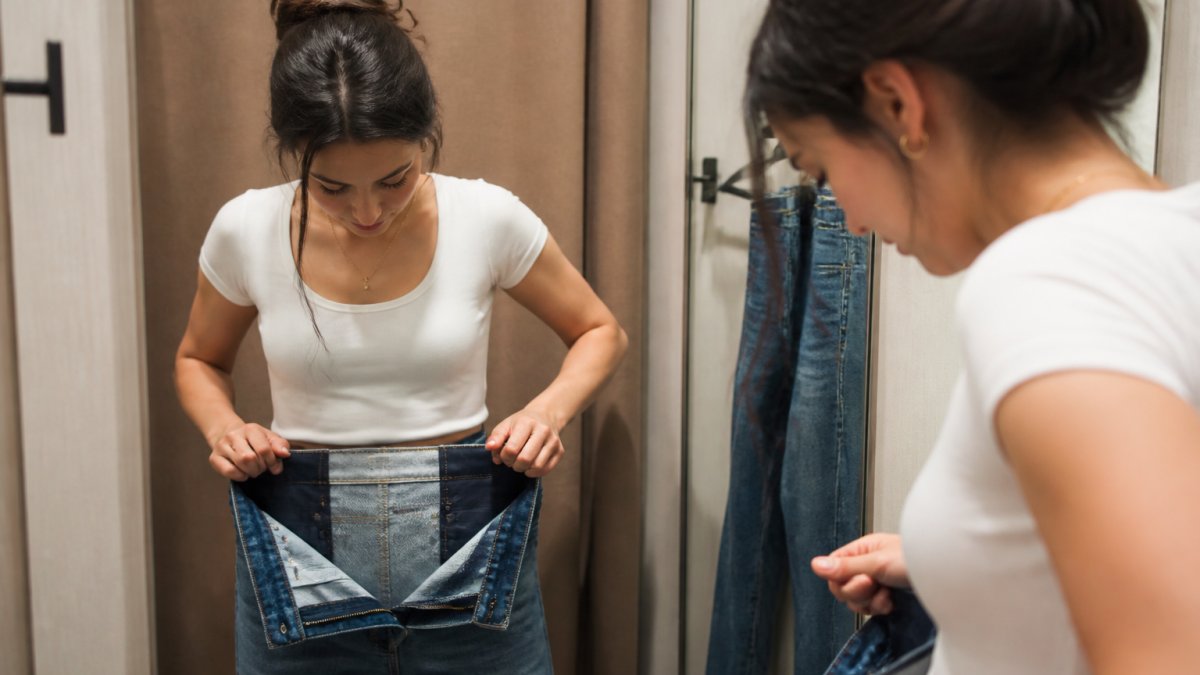
Compression Zones vs. a Single Front Panel
Single panels cover one area. Compression zones spread support across the lower belly and hips in bands. Zones move with you. A single panel fights you.
High-Rise vs. Mid-Rise for Real Waist Support
High-waisted denim wins for tummy control, and it is not close. A high rise reaches the natural waist, the narrowest part of your midsection, so the band has something to hold onto.
Mid-rise sits below the belly. It cannot smooth what it does not cover. Worse, it tends to roll down when you sit.
Here is the short version:
| Feature | High-Rise | Mid-Rise |
|---|---|---|
| Waist coverage | Full midsection | Below the belly |
| Support level | Strong | Light |
| Stays put when seated | Yes | Often rolls |
| Best for | Tummy control, longer torso | Short torso, casual looks |
If smoothing your midsection is the goal, start high. A mid-rise can work for a short torso, but it will never match the support.
Denim Stretch and Fabric Recovery: The Numbers That Matter
Stretch gets all the attention. Recovery is what keeps jeans looking good past the first wear. Recovery is a fabric's ability to snap back to its original shape after stretching, and it is determined almost entirely by which stretch fiber is in the blend and how much of it is there.
Most shoppers treat "stretch" as one thing. It is not. The three fibers you will see on a denim care label behave very differently over a full day and over a full year.
Elastane vs. Spandex vs. Polyester: What Each One Actually Does
Elastane and spandex are the same fiber. "Spandex" is the common name used in the United States; "elastane" is the international term.
Polyester is not a stretch fiber. It is a shape-retention fiber.
Cotton is the body. It provides the hand-feel, the breathability, and the weight. Too much cotton and the jean bags out. Too little and it stops feeling like denim.
A common pattern in denim that holds its shape well is roughly 70-80% cotton, 18-28% polyester, and 1-3% elastane/spandex.
Why Recovery Matters More Than Stretch Percentage
A high-stretch jean with poor recovery will sag at the knees and waist by mid-afternoon. A lower-stretch jean with good recovery will look the same at 6 p.m. as it did at 8 a.m. The stretch percentage tells you how far the fabric moves. The recovery tells you whether it comes back.
This is why a tummy control panel sewn into a low-recovery fabric fails. The panel holds, but the denim around it relaxes, and the smoothing effect disappears within a few wears.
How to Test Elasticity in 30 Seconds
- Grab a handful of fabric at the thigh
- Pull it out and hold for five seconds
- Let go
- Watch how fast it springs back
Snaps back flat? Good recovery. Stays stretched or wrinkled? It will sag on your body too.
How to Read a Fiber Label Before You Buy
- Look for polyester in the blend, it is a sign the fabric was built for shape retention
- Be cautious of 100% cotton tummy control jeans; without stretch, the panel cannot flex with you
Best Tummy Control Jeans for Office Wear
Office denim has to do two jobs.
That rules out thin, flimsy denim and anything that creases when you sit. It also rules out stiff shapewear-style panels that dig in by hour two.
What works is a high-waisted cut with a flexible compression panel and enough stretch to move. A wide leg keeps it professional and hides any bunching at the hip.

Our pick is the High-Waisted Wide Leg Jeans from AVERA7.
How to Style Wide-Leg Jeans for a Slimming Effect
Wide-leg denim can absolutely read slimming. The trick is balance, not camouflage. A wide leg creates a long vertical line, and that line does the work.
Three rules to consider:
- Tuck or half-tuck your top to define the waist
- Choose a fitted top over a baggy one to offset the volume below
- Add a heel or a pointed flat to extend the leg line
A structured blazer over a tucked tee is the easiest office version. Swap to a fitted knit and sneakers for weekends.
The hip-lifting effect matters here. It lifts the seat and balances the width of the leg, so the silhouette reads intentional rather than frumpy.
A Visual Fit Guide: Measuring Inseam, Rise, and Waist-to-Hip Ratio
Two minutes with a soft tape measure saves a return. This is the part most shoppers skip, and it is the reason online denim has such a high return rate. Here is how to take each measurement correctly, and what the numbers actually tell you.
How to Measure Inseam
Use your best-fitting pair, not your body. Lay the jeans flat on a bed or floor and smooth out any wrinkles.
- Find the crotch seam, the point where the two inner leg seams meet
- Measure straight down the inner leg to the hem
- Write that number down in inches
That is your inseam. Match it when you order. If you are between two inseams, size up for a full-length look or down for a cropped look.
How to Measure Rise
Rise is the distance from the crotch seam up to the top of the waistband. Lay the jeans flat and measure straight up from the crotch seam to the top edge of the band.
General ranges for women's denim:
- Low rise: 7-8 inches
- Mid rise: 8-9 inches
- High rise: 10 inches or more
For tummy control, you want a high rise, 10 inches or higher, so the band reaches your natural waist. Anything under 9 inches will sit below the belly and cannot smooth it.
How to Measure Waist-to-Hip Ratio
This is the measurement that predicts whether a pair will gap at the waist or dig into the hip. Take it on your body, not on the jeans.
- Measure your natural waist, the narrowest point of your torso, usually just above the belly button
- Measure your hips, the fullest point, usually 7-9 inches below the waist
- Divide your waist measurement by your hip measurement
A common pattern:
- Ratio under 0.75: You likely need a curvy cut with extra hip room and a contoured waistband
- Ratio 0.75-0.85: Standard cuts usually work
- Ratio above 0.85: You likely need a straighter cut with a wider waistband to avoid gaping
Write all three numbers down, inseam, rise, and waist-to-hip ratio. Now you can shop online with real data instead of guesswork.
How to Use These Numbers When You Order
- Match inseam to the product's listed inseam, not your height
- Match rise to the support level you want (10 inches or more for tummy control)
- Use your waist-to-hip ratio to decide between a standard and a curvy cut
- Check the return window before you buy, so you can test the fit at home without risk
What to Ignore When Shopping for Tummy Control Denim
Ignore the size on the tag. Sizing varies wildly between brands, and a number tells you nothing about how denim will sit on your body.
Ignore "one-size-fits-all" claims. Bodies are not one size, and neither is a good fit.
Ignore photos of models who are not shaped like you. Look for real customer photos on real bodies.
Ignore a rock-bottom price if the fabric has no recovery. You will replace the pair in a season.
What should you trust? The panel construction, the rise, the fabric recovery, and the return policy.
Frequently Asked Questions
What features should I look for in tummy control jeans?
Look for a wide, structured waistband with compression zones rather than a single thin elastic strip. Check that the front panel has shape retention built in, not just stretch. A high-waisted cut that sits above your natural waist gives more midsection smoothing than a mid-rise. Fabric matters too: a cotton-polyester blend with high elasticity and good recovery holds its shape through a full day of wear without sagging or bunching.
Do wide-leg jeans offer effective tummy control?
Yes, when the waistband and front panel are designed for it. The wide leg balances the silhouette by adding volume below the hip, which makes the waist look narrower by contrast. A hip-lifting effect at the back and a high-rise front keep the midsection smooth. The key is that the tummy control comes from the waistband construction, not the leg shape, so a relaxed wide leg can still deliver a flattering fit.
How can I tell if tummy control jeans will be comfortable for all-day wear?
Try the sit test: sit down in them and check whether the waistband digs in or rolls. If it does, the compression is too aggressive. Look for high elasticity in the fabric blend and a waistband that stays flat when you bend. A good pair should feel supportive but not restrictive. Many shoppers find that cotton-polyester blends with high stretch move with you through a workday without needing adjustment.
How do high-waisted jeans help with tummy control?
A high waistband extends above your natural waistline, covering the lower abdomen and creating a smoother line under tops. The extra height gives the fabric more surface area to distribute compression evenly, so it avoids the ridge that shorter waistbands create. It also stays in place when you sit or move, which keeps the midsection smoothing consistent. Pair it with a structured front panel and you get waistline definition without constant readjusting.
Finding denim that smooths your midsection and stays comfortable past lunch is harder than it should be. Most pairs force a choice between support and softness. AVERA7 built its high-waisted wide-leg jeans to end that trade-off, with a tummy control waist, a hip-lifting cut, and a soft cotton blend made for all-day wear. The 4.8 out of 5 rating and 30 Day Money Back Guarantee mean you can try them without risk. Get started with AVERA7 and find the pair that fits your body, not the size tag.