
High Waisted vs Mid Rise Jeans: Comfort Guide
Table of Contents
- High Waisted vs Mid Rise Jeans Comfort: The Core Differences
- How to Measure Jean Rise at Home
- Fabric Composition and Stretch: What Actually Makes Jeans Comfortable
- Best Jeans for Hourglass Body Shape: Rise and Silhouette Balance
- Jeans with Tummy Control: What High Rise Does Differently
- Torso Length and Body Type: Choosing Your Rise
- Conclusion: Which Rise Wins for All-Day Comfort?
- Frequently Asked Questions
Last Updated: September 28, 2026
High Waisted vs Mid Rise Jeans Comfort: The Core Differences
The high waisted jeans vs mid rise jeans comfort debate comes down to where the waistband sits. A high rise lands at or above your natural waistline; a mid rise sits 2 to 3 inches below it, closer to the hip bone. That single difference changes how denim feels all day.
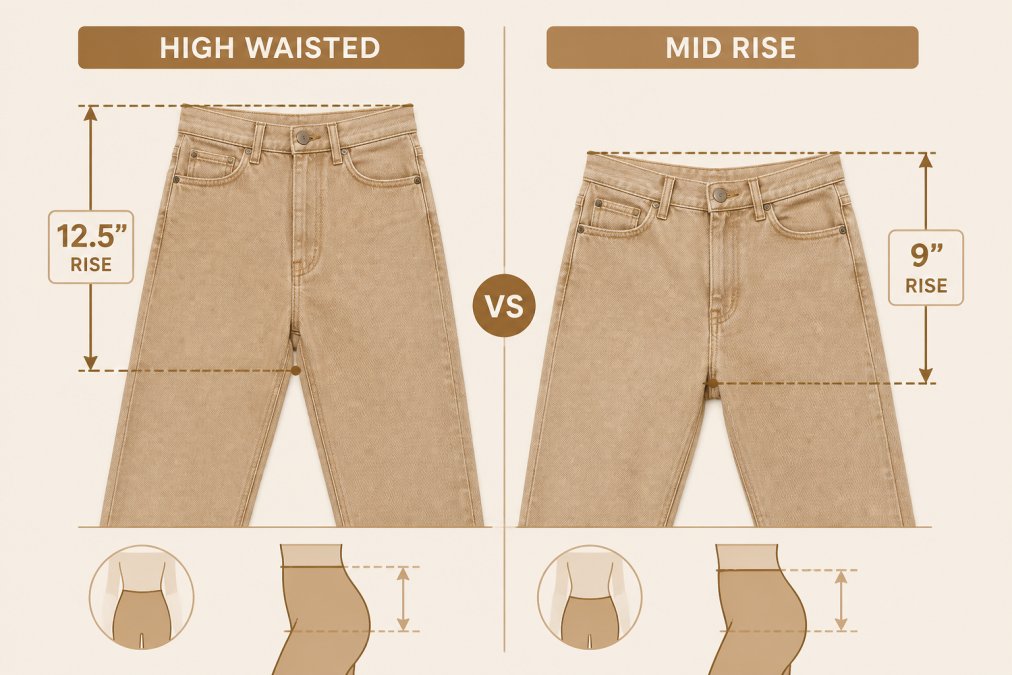
Waistband Placement and Crotch Depth
Waistband placement decides where denim grips your body. High rise wraps the smallest part of your natural waistline. Mid rise rests on the hip, where the body is wider and curvier.
How Rise Height Changes Sitting vs Standing Comfort
Standing comfort favors mid rise, since the waistband sits on the hip with less bunching at the mid-section. Sitting comfort favors high rise: when you sit, your torso compresses and the waistband shifts upward, so a high rise stays put while a mid rise slides down and gaps at the back. Try jeans on a stool, not just in front of a mirror, and sit for two full minutes before deciding.
How to Measure Jean Rise at Home
Measuring jean rise takes about 60 seconds and one soft tape measure. Lay your best-fitting pair flat.
Steps:
- Button and zip the jeans closed
- Lay them flat, front side up
- Find the crotch seam where the inseams meet
- Measure straight up to the top edge of the waistband
- Write down the number in inches
Now measure your body, not the jeans:
- Natural waistline: the narrowest point of your torso, usually just above the belly button
- Hip: the fullest part of your seat
- Hip-to-waist ratio: divide hip measurement by waist measurement
Fabric Composition and Stretch: What Actually Makes Jeans Comfortable
Rise sets where the waistband sits; fabric decides whether it feels like a hug or a clamp. Two pairs with identical rise measurements can feel completely different depending on fiber blend, stretch percentage, and recovery. Stretch percentage also changes how a high rise and a mid rise behave, in opposite directions.
How Stretch Percentage Changes Each Rise
Stretch is listed on the care tag as a percentage of elastane, spandex, or Lycra. The range that matters runs from 0% (rigid) to about 4% (high stretch).
- Rigid denim (0-1% stretch): Holds its shape but has almost no give. On a high rise it can press into the ribs when you sit; on a mid rise it tends to gap at the back waistband because the fabric cannot follow the hip as it flexes.
- Mid stretch (1-2%): The most common range for everyday jeans. Enough give to sit and bend without strain, enough structure to keep the waistband from rolling. This is the range where high rise and mid rise feel closest in comfort.
- High stretch (3-4%+): Soft on the first wear but recovers poorly. High-stretch high rise jeans stretch out at the waist and slide down by afternoon; high-stretch mid rise jeans bag at the seat and knees. The initial comfort is real; the all-day comfort often is not.
Denim Weight, Recovery, and Fabric Tension
Denim weight, measured in ounces per square yard, tells you how the fabric will behave before you put it on.
- Lightweight (under 10 oz): Soft and drapey, but sags faster at the waist and seat, a bigger problem on a mid rise that already relies on grip.
- Midweight (10-12 oz): The everyday sweet spot. Enough body to hold a waistband shape, enough softness to break in within a few wears.
- Heavyweight (12 oz and up): Structured and durable. Rigid heavyweight denim on a high rise can feel restrictive across the midsection until it breaks in, which can take several wears.
What to Look For on the Tag
A practical checklist when you are comparing two pairs:
- Check the elastane percentage first. Under 1% is essentially rigid, 1-2% is the everyday range, and over 3% is high stretch that loses shape faster.
- Check the cotton percentage. Higher cotton means better structure and recovery; polyester-heavy blends feel softer but pill and lose shape sooner.
- Check the weight if listed. Midweight (10-12 oz) balances structure and softness for most people.
- Do the sit test in both pairs. Stretch behaves differently when you sit, and the difference shows up within two minutes.
Best Jeans for Hourglass Body Shape: Rise and Silhouette Balance
The best jeans for hourglass body shape balance a defined waist with fuller hips and thighs: a rise at the natural waistline and a leg that doesn't fight your curves. Hourglass figures have a hip-to-waist ratio around 1.25 or higher, so mid rise jeans often gap at the back while high rise jeans hug the waist and release over the hip.
| Rise | Best For | Watch Out For |
|---|---|---|
| High rise | Hourglass, pear shape, apple shape | Digging if crotch depth is shallow |
| Mid rise | Rectangle, athletic builds | Waist gap on curvy hips |
| Low rise | Long torsos, straight builds | Mid-section exposure when sitting |
Jeans with Tummy Control: What High Rise Does Differently
Jeans with tummy control work by placing fabric tension across the mid-section, which high rise does naturally because the waistband sits above the belly rather than across it. Mid rise sits right where most people carry extra weight, creating a ridge or roll under a shirt, while high rise smooths the area instead of cutting into it.
Torso Length and Body Type: Choosing Your Rise
Torso length decides which rise looks and feels best, but the more useful measurement is the torso-to-leg ratio. Two people can both have a "long torso" and still need different rises, because what matters is how torso length compares to leg length, not torso length alone.
The Torso-to-Leg Ratio, Explained
The torso-to-leg ratio compares the distance from your natural waistline to your crotch (torso length) with the distance from your crotch to the floor (leg length). You don't need exact numbers, just which one is proportionally longer.
- Long torso, shorter legs: The waist sits high relative to the leg line. A high rise lands at or above the natural waist and can look and feel like it is riding up toward the ribs. A mid rise often lands right at the natural waist and reads as proportional.
- Short torso, longer legs: The waist sits low relative to the leg line. A high rise lands at the natural waist and balances the proportion. A mid rise can sit below the natural waist and create a gap at the back when you sit.
- Balanced torso and legs: Either rise works. Choose based on comfort and the sit test, not on rules.
Why Waistband Digging Happens Differently for Each Ratio
Waistband digging is about where the waistband lands relative to the natural waist and how much the torso compresses when you sit. When you sit, your torso shortens and your waistband shifts upward. On a long-torso, shorter-leg frame, a high rise that already sits near the ribs has little room to shift before pressing into the ribcage, that's the digging sensation.
A Quick Self-Check
You can estimate your ratio without a tape measure:
- Stand sideways in front of a mirror.
- Find your natural waistline, the narrowest point of your torso.
- Note where your crotch sits relative to your overall height.
- If your natural waist sits high relative to your crotch, you lean long-torso; if it sits low, you lean short-torso.
Conclusion: Which Rise Wins for All-Day Comfort?
For most people, high rise wins for all-day comfort. It stays put when you sit, covers the mid-section, and works with your natural waistline instead of against it. Mid rise works well for shorter torsos and those who prefer a lower waistband feel.
Frequently Asked Questions
Which is better for tummy control: mid-rise or high-rise jeans?
High-rise jeans generally provide more tummy control because the waistband sits above the natural waistline, covering the mid-section and holding it in place. Mid-rise sits lower, around the hip bones, so it offers less coverage in that area. If tummy control is your priority, look for high-waisted styles with a wide, structured waistband and enough stretch to move with you rather than dig in.
What body type should wear mid-rise jeans?
Mid-rise jeans suit people with shorter torsos, since the lower waistband creates more visual length in the torso. They also work well for apple shapes who find high-rise waistbands uncomfortable when seated, and for anyone who prefers a relaxed, casual look. Pear shapes may prefer high-rise for hip coverage. The right choice depends on your torso-to-leg ratio more than a single body type label.
How do you determine the rise of a pair of jeans?
Measure from the crotch seam, where the inseam meets the front and back panels, straight up to the top edge of the waistband. Use a flexible tape measure and lay the jeans flat. Under 8 inches is low rise, 8 to 9.5 inches is mid rise, and 10 inches or more is high rise. Comparing this number to your own natural waistline position tells you exactly where the waistband will land on your body.
Are high-waisted jeans comfortable enough to wear all day at work?
It depends on the fabric and waistband construction. High-waisted jeans with high elasticity and a soft cotton-polyester blend move with your body and stay comfortable through sitting, standing, and walking. The key is avoiding rigid denim with no give, which digs in when you sit. A style like AVERA7's High-Waisted Wide Leg Jeans uses high-elasticity fabric and a hip-lifting cut designed for all-day soft comfort, making them a practical option for work-to-weekend wear.
Finding jeans that stay comfortable from morning to evening is harder than it should be. Most pairs either dig in when you sit or gap at the back by afternoon. AVERA7 designed its high-waisted wide-leg jeans to solve both problems, with a curved high waistband for tummy control, a hip-lifting effect for a sculpted look, and a soft cotton-polyester blend for all-day wear. Get started with AVERA7 and find a pair that feels as good at 6 p.m. as it did at 8 a.m.