
How to Fix a Tight Jeans Waistband Without Sewing
Table of Contents
- Why Denim Tightens Up (And What You Can Actually Change)
- The Jeans Waist Extender Hack That Works in Seconds
- How to Stretch a Jeans Waistband With Warm Water and Steam
- No-Sew Waistband Modifications: Safety Pins and Waistband Adjustments
- Fabric Limitations: What Works on Cotton Blend vs. Spandex Denim
- Temporary Fixes vs. Permanent Solutions: Durability and Reversibility
- Choosing Comfortable High-Waisted Jeans That Fit Right the First Time
- Frequently Asked Questions
Last Updated: September 16, 2026
Why Denim Tightens Up (And What You Can Actually Change)
Denim tightens for three reasons: cotton shrinks with heat and moisture, spandex fibers fatigue, and your body fluctuates. The waistband is where all three converge, so fixing a tight jeans waistband without sewing starts with understanding what you're working with.
Cotton Incorporated fabric care guidance
The Jeans Waist Extender Hack That Works in Seconds
The fastest way to fix a tight jeans waistband without sewing is a button extender. This small elastic loop with a metal button hooks over your existing jeans button and creates extra room instantly, no tools, no waiting, no risk to the garment.
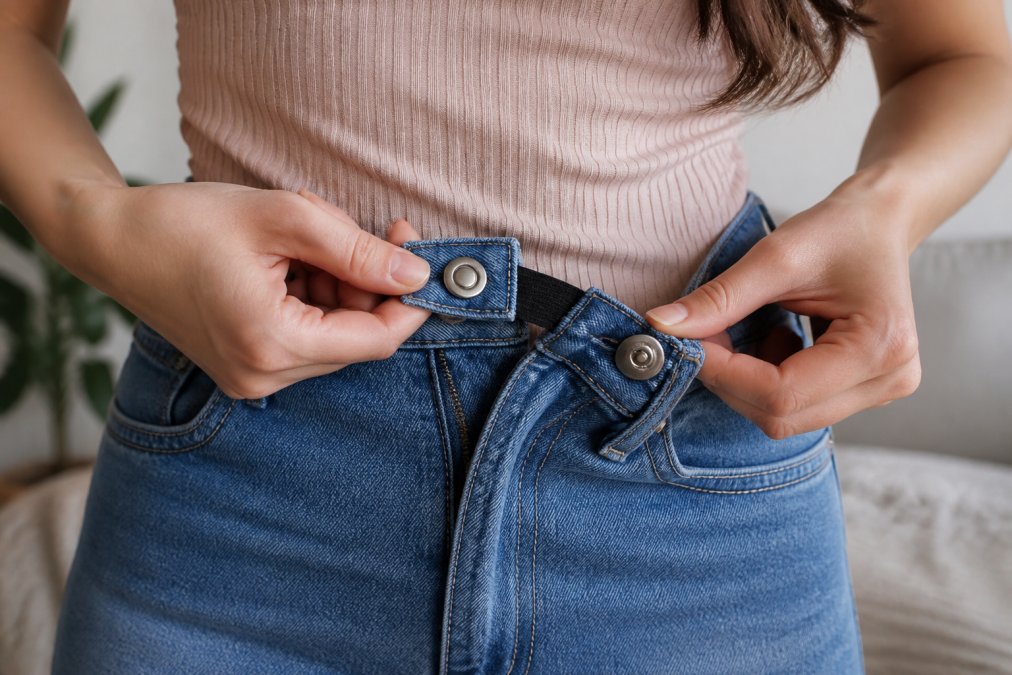
Button Extenders and Elastic Loop Options
Button extenders come in two styles. The classic version is a short elastic band with a button on one end and a buttonhole on the other: loop the buttonhole over your jeans' button, then fasten using the extender's button. This adds roughly half an inch to an inch of breathing room.
The Hair Tie and Rubber Band Trick
The hair tie trick is the zero-cost version: loop a thick hair tie or rubber band through your jeans' buttonhole, then stretch it over the button. This creates tension that holds the waistband closed while adding give.
How to Stretch a Jeans Waistband With Warm Water and Steam
Warm water and steam relax cotton fibers temporarily. This is how to stretch a jeans waistband when the tightness is mild and you have 30 minutes to spare. The effect fades after a wash, so treat it as temporary, not a permanent alteration.
Warm Water Soak Method
Fill a bathtub or large basin with lukewarm water, not hot, which shrinks cotton further and damages spandex. Submerge the waistband for 15 to 20 minutes, then gently pull the fabric outward while wet, focusing on the sides and back, not the front closure.
Ironing and Steaming Techniques
Steam is more targeted than a full soak. Hang your jeans and steam the inside of the waistband in sections, stretching gently with your hands while the fabric is warm and damp. Hold each section a few seconds before moving on.
No-Sew Waistband Modifications: Safety Pins and Waistband Adjustments
Safety pins are the most misunderstood tool here. They're excellent at taking a waistband in and nearly useless at letting one out, because a pin can only remove slack, it can't create fabric that isn't there. If your jeans dig in, a pin alone won't loosen anything; it can only reposition where the waistband closes, changing how pressure is distributed across your midsection.
When Safety Pins Actually Help
There are three real use cases, each depending on your jeans' closure style:
- Two-button or button-fly closures. If your jeans have a second button set back from the front edge, fasten the inner button and let the outer edge overlap slightly. This shifts the closure point inward by roughly half an inch and reduces pull across the front. No pin required, but a safety pin can hold the overlapping flap flat if it flares.
- Back-waistband pinch. For jeans that gap at the back but dig in at the front, fold a small pleat inside the back waistband and pin it from the inside. This is a tailoring move, not a stretching move, it makes the waist smaller, not larger, so it only helps if the tightness is localized to the front.
- Belt-loop anchoring. A pin threaded through a belt loop and around your belt can stop a too-loose waistband from sliding down, which indirectly relieves the downward drag that makes a snug waist feel tighter.
Hardware Choices and Their Trade-Offs
Not all safety pins are equal on denim. Standard nickel-plated pins are thin gauge and bend or pop open under waistband tension within a few wears. Look for stainless steel pins in size 2 or 3, the larger gauge holds its coil and resists rust through washing. Coilless pins are gentler on fabric but slip more easily.
Other No-Sew Adjustments Worth Knowing
- Elastic buttonhole trick. Some jeans have a hidden buttonhole inside the waistband near the side seam. Threading a short length of 1/4-inch elastic through it and anchoring the ends to a belt loop creates a subtle gather that pulls the waist in. This is a taking-in method, not a letting-out method, but it's fully reversible.
- Snap-in waistband extenders. These use a metal snap instead of a button and sit flatter under a belt than elastic-loop extenders. They're the better choice for wide, high-rise waistbands where a bulge at the closure is visible.
- Belt as pressure redistributor. A belt doesn't loosen a waistband, but a wide (1.5-inch or more) belt spreads the load across a larger area of your torso, which can turn a pair that pinches into a pair you can wear for a full workday. A thin fashion belt concentrates pressure and makes tightness worse.
The Honest Limit
No-sew modifications top out at roughly one inch of adjustment. Beyond that, you're fighting the garment's construction, the interfacing, the multiple fabric layers, and the fixed distance between button and buttonhole. If your jeans are more than an inch too tight at the waist, no pin, extender, or trick will keep them comfortable for more than an hour.
Fabric Limitations: What Works on Cotton Blend vs. Spandex Denim
Most guides treat denim as one material. It isn't. The fiber content on your care label determines which methods work, which fail silently, and which damage the garment in ways you won't notice for months. This decides whether your fix lasts a day or a season.
How to Read Your Care Label
Look for a percentage breakdown, usually printed as "98% Cotton, 2% Elastane" or "70% Cotton, 28% Polyester, 2% Spandex." The number that matters most for waistband fixes is the elastane/spandex figure. Here's the practical breakdown:
| Fabric Type | Stretch Potential | Best Method | Durability of Fix |
|---|---|---|---|
| 100% cotton denim | Moderate | Warm water soak + wear | Fades after each wash |
| Cotton with 1-2% spandex | High | Button extender | Lasts as long as hardware holds |
| Cotton with 3%+ spandex | Very high | Steam + gentle stretch | Temporary, fades in days |
| Rigid selvedge denim | Low | Professional tailoring | Permanent but costly |
Why 100% Cotton Behaves Differently
Pure cotton denim has no elastic recovery. When you stretch it, the fibers slide past each other and stay put, until water and agitation reset the structure. That's why the warm water soak works: you're temporarily disrupting the hydrogen bonds between cellulose fibers, then letting them dry in a new position. Wear the jeans for an hour while slightly damp and the waistband molds to your body.
Why Spandex Blends Fight Back
Spandex (also labeled elastane or Lycra) is a segmented polyurethane fiber that stretches to several times its length and snaps back, exactly the problem for waistband fixes. Any stretching you do to a spandex blend is temporary by design, because the elastic fibers actively pull the fabric back to its manufactured dimensions.
The Long-Term Durability Question
Not all hacks are equal when you look at what they do to the garment over months of use:
- Button extenders and snap extenders. Lowest risk. They change the closure point without touching the fabric. The only wear is on the buttonhole, which stretches slightly over time.
- Hair ties and rubber bands. Moderate risk. Metal clasps on hair ties abrade the denim around the buttonhole; thin rubber bands leave residue that attracts lint and can stain light washes.
- Warm water soaks. Low fabric risk, but repeated soaking accelerates indigo loss at the waistband, which fades faster than the rest of the jean.
- Steam and iron stretching. High risk on spandex blends. Safe on 100% cotton if you use a pressing cloth and keep the iron moving.
- Cutting the waistband. Irreversible. Once you cut, the interfacing is exposed and the waistband will fray unless you seal it, which requires sewing, defeating the no-sew premise.
Matching Method to Fabric
The rule of thumb: the more spandex in your jeans, the less you should change the fabric and the more you should change the hardware. A button extender on a 4% spandex jegging works indefinitely; a warm water soak on the same pair feels great for one wear, then snaps back.
Federal Trade Commission textile labeling requirements
Temporary Fixes vs. Permanent Solutions: Durability and Reversibility
Every method here is either a temporary fix that buys comfort for a day or a week, or a permanent change that alters the garment for good.
Temporary fixes:
- Button extenders and hair ties (reversible, lasts until removed)
- Warm water soak (fades after one wash)
- Steam and stretch (fades within days)
Permanent changes:
- Professional waistband alteration (irreversible, changes the garment)
- Cutting the waistband (irreversible, risky)
- Ironing with high heat on spandex (damages fibers permanently)
Choosing Comfortable High-Waisted Jeans That Fit Right the First Time
The most effective way to avoid tight waistbands is to choose jeans engineered for comfort. AVERA7 designs high-waisted wide-leg jeans with a relaxed vintage-inspired fit and built-in tummy control that supports without digging in.
Frequently Asked Questions
How can I stretch out the waistband of my jeans without sewing?
The fastest no-sew approach is a button extender or elastic loop, which adds roughly an inch of give at the closure. For a more lasting change, spritz the waistband with warm water, then stretch it gently with your hands or use a hair tie looped through the buttonhole. Steam from an iron can also relax cotton blend fibers. None of these methods permanently resizes the denim, so expect to repeat them after each wash.
Does soaking jeans in water help loosen the waistband?
A warm water soak can relax cotton fibers temporarily, making the denim easier to stretch while damp. Fill a tub with warm (not hot) water, submerge just the waistband for 10 to 15 minutes, then stretch and wear or hang to dry. The effect fades after washing, and spandex-heavy denim responds less because synthetic fibers recover their shape. Hot water risks shrinkage and dye loss, so keep the temperature moderate.
Can you use a hair tie to loosen tight jeans?
Yes. Loop a hair tie or rubber band through the buttonhole, then stretch it over the button to create extra waist room. This jeans waist extender hack takes seconds and is fully reversible. Thicker fabric-covered elastics hold better than thin bands, which can snap under tension. It works best as a short-term fix for a waist gap or a slightly snug fit rather than a permanent adjustment.
Are there temporary fixes for tight denim waistbands?
Most no-sew methods are temporary by nature. Button extenders, hair ties, and safety pins add immediate room but reset once removed. Warm water and steam stretching holds until the next wash. If you want a lasting change, a tailor can take in or let out the waistband properly. For denim that fits well everywhere except the waist, choosing a cut with built-in stretch or tummy control can solve the problem at the source.
Tight jeans are a fit problem, and fit problems have real solutions. Whether you need a quick button extender fix or you're ready to invest in denim that fits correctly from the start, AVERA7 offers high-waisted wide-leg jeans with tummy control, a hip-lifting effect, and all-day soft comfort in multiple versatile colors. Get started with AVERA7 and find jeans that feel as good at hour ten as they did at hour one.