
How to Hem Wide Leg Jeans at Home: Complete 2026 Guide
Table of Contents
- Tools and Materials You Need to Hem Wide Leg Jeans
- How to Measure Inseam for Wide Leg Jeans
- How to Keep the Original Hem on Jeans
- Step-by-Step: Pinning, Sewing, and Trimming Your Wide Leg Jeans
- Hemming Jeans Without a Sewing Machine
- Handling Stretch Denim vs Rigid Denim
- Pressing and Finishing for a Professional Look
- Frequently Asked Questions
Last Updated: September 16, 2026
Tools and Materials You Need to Hem Wide Leg Jeans
Hemming hem wide leg jeans at home takes about an hour and a few inexpensive tools, and the payoff is a pair that breaks exactly where you want it.
Here's what to gather before you start:
- Sewing machine with a heavy-duty or denim-capable needle (size 90/14 or 100/16)
- Denim thread in a shade that matches your topstitching
- Zipper foot for clean stitching close to the folded edge
- Fabric chalk or tailor's chalk for marking your new hemline
- Sewing gauge or a straight edge ruler
- Pins or clips (clips grip thick denim better than pins)
- Seam ripper for undoing the original hem
- Sharp fabric scissors and an iron
How to Measure Inseam for Wide Leg Jeans
To measure inseam for wide leg jeans, run a tape from the crotch seam straight down the inside of the leg to where you want the hem to fall. Wear your intended shoes, stand naturally, and write down that number, it's your target finished inseam.
Finding Your Perfect Hem Length
Wide leg silhouettes change where the hem should sit: a full break that looks intentional on a straight leg can swallow a flare.
- Full length: hem sits just above the shoe with a slight break
- Cropped: 1-2 inches above the ankle bone
- Puddle: hem rests on top of the shoe with visible folds
Accounting for Shrinkage and Fabric Weight
Denim moves after washing. Rigid cotton can shrink noticeably on the first hot wash; stretch denim holds its shape better but relaxes with wear. Pre-wash before hemming if you plan to wash warm; if you always wash cold and hang dry, hem to your measured length. Heavy denim also hangs differently, so 12 oz fabric may need slightly more length than 9 oz to drape the same way.
How to Keep the Original Hem on Jeans
Keeping the original hem preserves the factory-finished edge, including the fading and stitching that make a pair look intentionally worn. The fold-and-stitch method works especially well on wide leg jeans because the leg opening is wide enough to maneuver under the needle.
The Fold-and-Stitch Method
- Try the jeans on and mark your target length with fabric chalk.
- Measure the distance between your mark and the original hem, then divide that number in half.
- Turn the jeans inside out and fold the excess fabric up so the original hem sits at your mark.
- Pin or clip along the fold, keeping the fold line straight all the way around.
- Sew a straight stitch just above the original hem, through all layers.
- Trim the excess fabric above your stitch line, leaving a small hem allowance.
- Press the seam flat and finish the raw edge with a zigzag or overcast stitch.
The result keeps the factory hem visible while shortening the leg, and on a wide leg the folded bulk stays hidden inside.
Step-by-Step: Pinning, Sewing, and Trimming Your Wide Leg Jeans
Pinning, sewing, and trimming turn a measurement into a finished hem. Work slowly and check the fold from both sides.
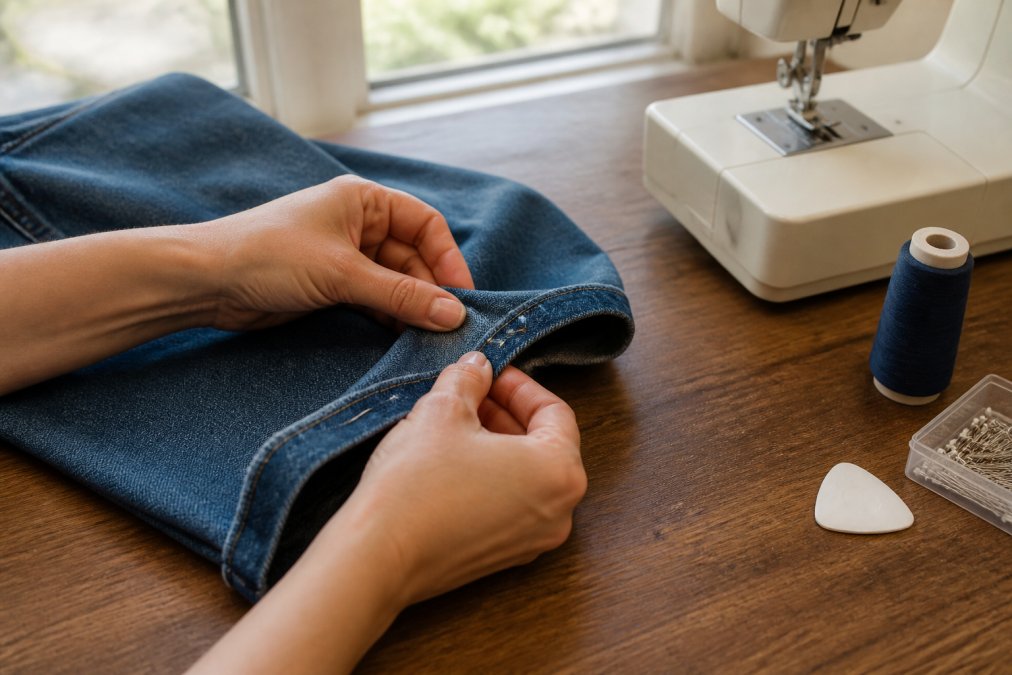
Sewing Machine Settings for Denim
Denim weight dictates your settings: a denim needle, a longer stitch length (3 to 3.5 mm), and slightly looser thread tension than on cotton. The heavy needle punches through thick folds without bending, and the longer stitch prevents puckering.
Using a Zipper Foot for Clean Topstitching
A zipper foot lets you sew close to the folded edge without the presser foot riding up onto the fold, the difference between topstitching that looks intentional and topstitching that wanders.
Trimming Excess Fabric Without Unraveling the Seam
Trim after you sew, not before. Cut the excess fabric above your stitch line, leaving a 3/8-inch to 1/2-inch allowance, an over-trimmed allowance causes a hem to pull loose at the side seams. Finish the raw edge with a zigzag, overcast, or serged stitch, then press flat. Skipping the raw-edge finish is the most common reason a home hem frays apart in the wash.
Troubleshooting Uneven Hems and Wavy Seams
Uneven hems trace back to three causes:
- The fold depth differs between legs. Lay both legs flat, align the waistbands, and measure from the original hem up to your stitch line on each leg. If the numbers don't match, unpick and re-pin rather than trimming to even.
- The fabric stretched as you sewed. The classic wavy-hem cause on stretch denim. Let the feed dogs pull the fabric; don't tug it from behind the needle. If the hem already waves, press with steam and let it cool flat before deciding whether to re-sew.
- The hem sits unevenly on the body. A hem can measure perfectly flat and still look off when worn, because one leg may hang differently. Try the jeans on and check in a full-length mirror from the side before trimming.
| Step | What You're Doing | Time |
|---|---|---|
| Measure and mark | Find your target inseam | 5 min |
| Pin the fold | Secure the new hemline | 5 min |
| Set up the machine | Needle, thread, tension, stitch length | 5 min |
| Stitch the hem | Straight stitch around the opening | 10 min |
| Trim excess fabric | Cut above the stitch line | 5 min |
| Press and finish | Iron the seam, finish raw edges | 10 min |
Hemming Jeans Without a Sewing Machine
If you don't own a machine, you have two paths: a heat-bonded no-sew hem or a hand-sewn blind stitch. They trade speed against durability, and the right pick depends on how often you wash the jeans and how heavy the denim is.
The No-Sew Hemming Tape Method
Fusible hemming tape is a strip of heat-activated adhesive web. Fold the hem to your marked length, tuck the tape inside the fold, and press with a hot iron until the adhesive melts and bonds the layers. It's the fastest option and the easiest to reverse, heat and steam release the bond.
How to do it:
- Turn the jeans inside out and fold the fabric up to your marked hemline, matching the fold depth on both legs.
- Cut a length of hemming tape to match the leg opening circumference.
- Slide the tape into the fold, sandwiched between the folded fabric and the leg, so no adhesive touches the iron.
- Press with a hot iron (follow the tape's package temperature) for the recommended dwell time, usually 10-15 seconds per section, working around the opening.
- Let the hem cool completely before moving the jeans. The bond sets as it cools, not while it's hot.
The Hand-Sewn Blind Stitch
A blind stitch is the hand-sewing method that holds up: nearly invisible from the outside, it flexes with the fabric and survives washing far better than tape. Plan on 20-30 minutes per leg on a wide opening, but it's the closest thing to a machine hem you can do by hand.
How to do it:
- Fold and pin the hem to your marked length, inside out, the same way you would for a machine hem.
- Thread your needle and knot the end. Work from the inside of the leg so your knots stay hidden.
- Bring the needle up through the folded hem edge, catching just one or two threads of the fabric, not a full stitch through to the outside.
- Take a tiny stitch into the leg fabric directly below where the needle came up, again catching only a thread or two.
- Move about 1/4 inch along the hem and repeat. The goal is a series of tiny, nearly invisible tacks that hold the fold in place without pulling.
- Keep your stitches loose. A tight blind stitch puckers the hem; a slightly relaxed one lies flat.
- Knot off on the inside when you reach the start, and press the hem flat with steam.
Which Method to Choose
- Hemming tape: fastest, reversible, best for a temporary fix or a gently washed pair. Weakest on heavy denim and at thick side seams.
- Hand-sewn blind stitch: slower, permanent, nearly invisible, and the better choice for a pair you'll wear and wash regularly.
If you're hemming a wide leg specifically, the wide opening gives you more room to work your needle and more surface area for either method to hold, which makes both options more forgiving than they'd be on a tapered leg.
Handling Stretch Denim vs Rigid Denim
Stretch denim and rigid denim behave differently under the needle, and treating them the same is why so many home hems pucker or wave. Stretch denim contains elastane, so it moves as you sew and can stretch out of shape if you pull it through the machine.
Pressing and Finishing for a Professional Look
Pressing separates a hem that looks homemade from one that looks tailored. Set your iron to the denim setting with steam, press the hem from the inside first, then flip the jeans and press the outside edge to sharpen the fold. Use a pressing cloth on dark or coated denim to prevent shine marks, and press along any visible topstitch line so it lies flat and crisp.
Frequently Asked Questions
Can wide leg jeans be hemmed?
Yes, wide leg jeans can be hemmed at home with basic sewing skills. The process involves measuring your inseam, pinning the new hem, and using a straight stitch on a sewing machine or a hand-sewn blind stitch. For the best results, match your thread to the original topstitch color and use a denim needle. If you want to keep the original hem, the fold-and-stitch method works well for wide leg styles.
How do I hem wide leg jeans without cutting?
You can hem wide leg jeans without cutting by folding the excess fabric up inside the leg and stitching close to the fold. This method, often called the 'fold-and-stitch' or 'original hem' technique, preserves the factory hem and is reversible. Use a zipper foot to stitch neatly along the folded edge, and press the hem flat. It works best on jeans with a straight or slightly flared leg, not on extreme flares.
Should I wash my jeans before hemming them?
Yes, wash and dry your wide leg jeans before hemming, especially if they are made of cotton denim that may shrink. Most denim shrinks about 2-3% in length after the first wash. Pre-washing ensures your final hem length stays accurate. If the jeans are labeled 'pre-shrunk' or have a high percentage of stretch fibers, shrinkage is minimal, but a quick wash still helps the fabric settle.
What is the best way to hem stretch denim vs rigid denim?
Stretch denim requires a ballpoint or stretch needle and a slightly longer straight stitch to avoid skipped stitches. Rigid denim needs a sharp denim needle and a standard stitch length. For both, use a walking foot if you have one to prevent the fabric from shifting. Always test on a scrap piece first. Stretch denim may also need a zigzag stitch for extra flexibility, while rigid denim holds a crisp press better.