
How to Make Premium Denim More Sustainable
Last Updated: November 1, 2026
Quick Summary
Sustainable denim manufacturing reduces impact mainly in finishing, where conventional indigo dyeing and washing consume heavy water, energy and chemicals. Brands can start by auditing their largest water and chemical inputs, then adopting low-water techniques, recycled fibers and transparent supplier data.
- Conventional indigo dyeing and finishing consume large volumes of water and energy and generate wastewater.
- Ask suppliers for measured water-per-garment figures with a stated measurement boundary.
- Low-water technologies like foam dyeing, e-flow and ozone fading each change process control and cost differently.
- Recycled cotton blends can shorten garment life, so judge fiber choice on lifetime impact.
- Demand documentation of effluent handling and supplier transparency, not just green labels.
Table of Contents
- Sustainable Denim Production: Where Brands Start
- Water-Saving Denim Finishing and Waterless Dyeing
- Recycled Cotton Denim and Fiber Choices
- Chemical Management, Laser Finishing and Wastewater
- Denim Supply Chain Transparency and Traceability
- Cost, Trade-offs and End-of-Life Garment Management
- How to Check a Denim Brand's Sustainability Claims Before You Buy
- Frequently Asked Questions
Denim is one of the most resource-intensive garments in the closet, and the strain sits mostly in the finishing stage rather than the cotton field. This guide walks through how premium denim can be made more sustainable, from fiber choice and dyeing methods to chemical management and supply chain transparency.
Conventional indigo dyeing and finishing consume large volumes of water and energy, and they generate wastewater that must be treated. A critical review of sustainability in denim documents these challenges across the production chain, including the search for workable alternatives to established methods (Critical Review on Sustainability in Denim: A Step toward Sustainable Production and Consumption).
Sustainable Denim Production: Where Brands Start
Most brands start with fiber and finishing rather than trying to fix everything at once. The review examines a range of approaches, including ozone fading, e-flow, enzyme-based bleaching, water reduction, and energy conservation, and it is clear that no single method solves every problem (Critical Review on Sustainability in Denim). In practice, a sensible starting point is to audit where your largest water and chemical inputs occur, then target those steps first.
Water-Saving Denim Finishing and Waterless Dyeing
Water is the defining cost and compliance pressure in denim finishing, and it is also where the marketing claims are thickest. The useful way to read this section is as a buyer's or production manager's map: what each low-water technology actually changes, what it does not change, and what number to demand before you believe a claim.
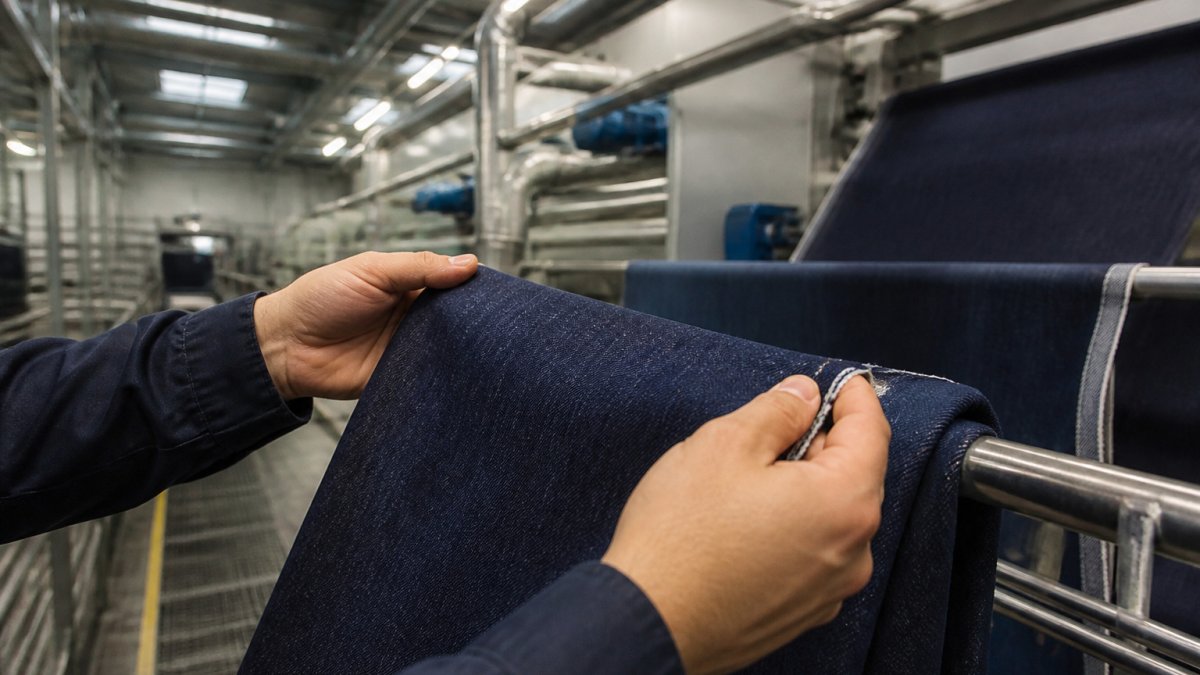
Where the water actually goes. In a conventional denim line, water load concentrates in three places: indigo dyeing and rinsing (the yarn or garment must be repeatedly washed and oxidized), desizing and bleaching before finishing, and the wash-down steps that create hand-feel and color variation. A factory that only swaps the final wash has not solved its water problem; the dyeing and rinsing stages usually dominate. This is why the literature treats water reduction as a process-chain problem rather than a single equipment purchase (Critical Review on Sustainability in Denim: A Step toward Sustainable Production and Consumption).
The main low-water technologies, and what each one does:
- Foam indigo dyeing. Indigo is applied as a foam rather than a liquid bath, which sharply cuts the water carried into the yarn and the rinsing needed afterward. The trade-off is process control: foam application is less forgiving than a dip bath, and shade consistency depends on tight monitoring.
- E-flow (advanced garment washing). A closed-loop, low-liquor process that uses a controlled mix of water, air, and chemicals to achieve wash effects, replacing several conventional wash steps. It reduces water and chemical consumption per garment but requires equipment investment and operator training.
- Ozone fading. Ozone gas substitutes for some bleach and stone-wash steps, cutting both water and chemical load. Ozone is generated on site and does not ship as a liquid chemical, which simplifies some handling, but it requires ventilation and safety controls.
- Laser finishing. Covered in more detail in the chemical-management section, laser replaces hand-sanding and some chemical sprays, reducing both water and abrasive waste.
- Enzyme-based bleaching and washing. Enzymes can replace harsher chemical bleaching and reduce the number of rinse cycles, though enzyme performance is sensitive to temperature and pH.
The number that matters: water per garment. Vendor-level targets such as "up to 90% less water" for a given dyeing approach are reported figures for that approach, not a guarantee for a specific factory (Specialty Fabrics Review, 2024).
The trade-offs buyers should expect. Low-water processes change the economics of a run. Equipment investment raises the fixed cost per style, which favors longer runs and penalizes small-batch development. Some low-water washes produce a narrower range of achievable looks, so a brand chasing a very specific vintage fade may find the low-water route constrains the design. And water savings do not automatically translate to energy savings, some low-liquor processes are energy-intensive per garment even as they cut water.
What to put in a supplier questionnaire. Ask for water-per-garment data by process step; the treatment method and discharge permit for effluent; whether the facility recycles process water and at what rate; and which of the technologies above are actually installed versus available on request. For a broader framework on reading supplier claims, see our guide on how to find high quality denim jeans.
Recycled Cotton Denim and Fiber Choices
Fiber selection shapes both sustainability and performance. Recycled cotton and blends with sustainable fibers are being evaluated in circular product development, with one 2025 case study assessing two circular denim products that incorporate such fibers (ScienceDirect circular denim case study, 2025). Stretch percentage is one of the fiber-blend factors that changes how these garments fit and wear, and our guide to picking the right denim stretch percentage walks through how to choose it. For everyday wear, fiber blends also affect stretch, recovery and durability, so a recycled fiber that softens fit or shortens garment life may not reduce impact over the product's lifetime.
Chemical Management, Laser Finishing and Wastewater
Chemical management is where many premium brands gain ground quickly. Laser finishing can replace some chemical and abrasive steps, and enzyme-based bleaching is another route studied in the literature (Critical Review on Sustainability in Denim). A 2025 study of a denim factory adopting sustainability-oriented technologies reported significant reductions in chemical use, though the source does not give measured figures (Iowa State University Digital Press 2025 Proceedings).
Wastewater treatment remains a central cost and compliance issue, so ask for documentation on how effluent is handled, not just whether a process is labeled "green."
Denim Supply Chain Transparency and Traceability
Sustainable denim discussions increasingly cover water use, carbon emissions, labor practices and supply chain transparency together (Associated Press, sustainability in denim coverage). A claim about one factor can leave others unaddressed. Transparent brands can name their mills and finishing facilities and share audit or process data. For a practical checklist on evaluating supplier claims, see our guide on how to find high quality denim jeans.
Cost, Trade-offs and End-of-Life Garment Management
Most sustainable-denim content stops at "it costs more but it's worth it." That is not useful to a factory deciding whether to invest or a brand deciding what to specify.
Where the cost premium sits. Sustainable upgrades are not one line item. They fall into four buckets, each with a different payback logic:
- Capital equipment (low-liquor washing, ozone, laser, foam dyeing). High upfront cost, fixed per style, so payback improves with volume and run length. The business case rests on reduced water, chemical, and energy spend per garment plus avoided compliance cost.
- Input substitution (recycled cotton, organic cotton, lower-impact stretch fibers). Usually a per-unit material premium. Payback is not internal, it is a brand-positioning and specification decision, so it belongs in the product brief, not the factory P&L alone.
- Process and certification overhead (audits, testing, traceability systems, certification fees). Recurring cost that scales with SKU count and supplier count; consolidating suppliers reduces it.
- Effluent and compliance cost. Treatment, permits, and monitoring are real operating costs that low-water and low-chemical processes can reduce, often the most defensible part of the investment case because it is measurable and recurring.
How to frame the payback. A credible internal case compares cost per garment against savings per garment across water, energy, chemicals, and treatment, then adds avoided compliance risk. The trap is comparing a capital purchase against a single season's savings; equipment lives for years and the savings recur.
The fiber durability trade-off. Recycled cotton and stretch blends can change hand feel, recovery, and abrasion resistance. A fiber that softens the fit or shortens garment life can raise total impact per year of wear even if its production footprint is lower. The honest framing is lifetime impact, not per-unit impact, which is why fiber choice belongs alongside durability testing, not separate from it. Our guide on choosing denim fabrics for everyday comfort covers how fiber choice plays out in wear over time.
End-of-life: what actually has to happen. "Circularity" in most articles means "recycle it." In practice, post-consumer denim recycling runs into three hard constraints:
- Collection and sorting. Denim must be separated from mixed-fiber garments and from trims (buttons, zippers, rivets) before it can be mechanically recycled. Sorting is labor-intensive and is the bottleneck most programs underestimate.
- Fiber damage. Mechanical recycling shortens cotton fibers, so recycled content usually has to be blended with virgin fiber to maintain strength, which caps how high recycled content can go in a durable garment.
- Chemical recycling capacity. Chemical recycling can recover fiber quality but is capital-intensive and capacity-constrained; it is not yet a drop-in solution at scale for most brands.
The MUD Jeans case study is often cited as a circular business model example, though the supplied source does not report measurable outcomes (The Future Is Circular: A Case Study on MUD Jeans).
A simple decision frame. For each sustainability upgrade, ask: is the cost capital or per-unit; is the saving measurable and recurring; does it improve or compromise durability; and does it make the garment easier or harder to repair and recycle? If you are weighing whether premium pricing reflects real quality, our article on whether expensive jeans are worth the price covers that trade-off.
| Factor | Conventional Process | Sustainable Alternative | Key Question to Ask |
|---|---|---|---|
| Water use | High volume per garment | Reported up to 90% reduction (Eco-Advanced Indigo) | Is water-per-garment measured, and within what boundary? |
| Energy | Standard process energy | Reported up to 30% reduction | What is the energy source, and what is the dollar saving per garment? |
| Chemicals | Heavy bleaching and finishing | Laser and enzyme methods | Is effluent documented and permitted? |
| Fiber | Virgin cotton | Recycled cotton blends | How does it affect durability and recyclability? |
| End-of-life | Landfill or downcycle | Design for disassembly, repair, recycling | Are trims removable and fiber content documented? |
How to Check a Denim Brand's Sustainability Claims Before You Buy
Start by asking whether a claim covers water, energy, chemicals, labor and fiber, or only one of them. Then ask for specifics: which facility, which process, and what measured reduction. Vague language such as "eco-friendly" without data is a signal to dig deeper. If you want to see the specifications, colors and sizing for our high-waisted wide-leg jeans, review the High-Waisted Wide Leg Jeans, priced at $39.99.

Frequently Asked Questions
What makes denim manufacturing sustainable?
Sustainable denim manufacturing reduces the environmental load at each stage: fiber selection, dyeing, finishing and wastewater treatment. A critical review in PubMed Central (2023) also notes that no single technique solves every problem, so the strongest programs combine several measures and track results across the whole process.
Is recycled cotton better for denim than conventional cotton?
Recycled cotton can reduce demand for virgin fiber, but the answer depends on the blend, the recycling process and the product's end-of-life plan. Research on circular denim products, including a 2025 ScienceDirect case study of two products built with sustainable fibers, shows the approach is being tested in practice, but the sources reviewed do not give a single measured advantage over conventional cotton. Shoppers should ask brands for fiber content and any third-party verification.
How can shoppers tell whether a denim brand uses sustainable manufacturing practices?
Look for specifics rather than general claims. Useful signals include disclosed fiber content, named dyeing or finishing methods, water and energy figures, and information about factories and labor practices. The Associated Press describes denim sustainability as covering water use, carbon emissions, labor and supply-chain transparency, so a claim about only one of these leaves others unaddressed. Brands that publish their supplier list and processing methods are easier to verify.
